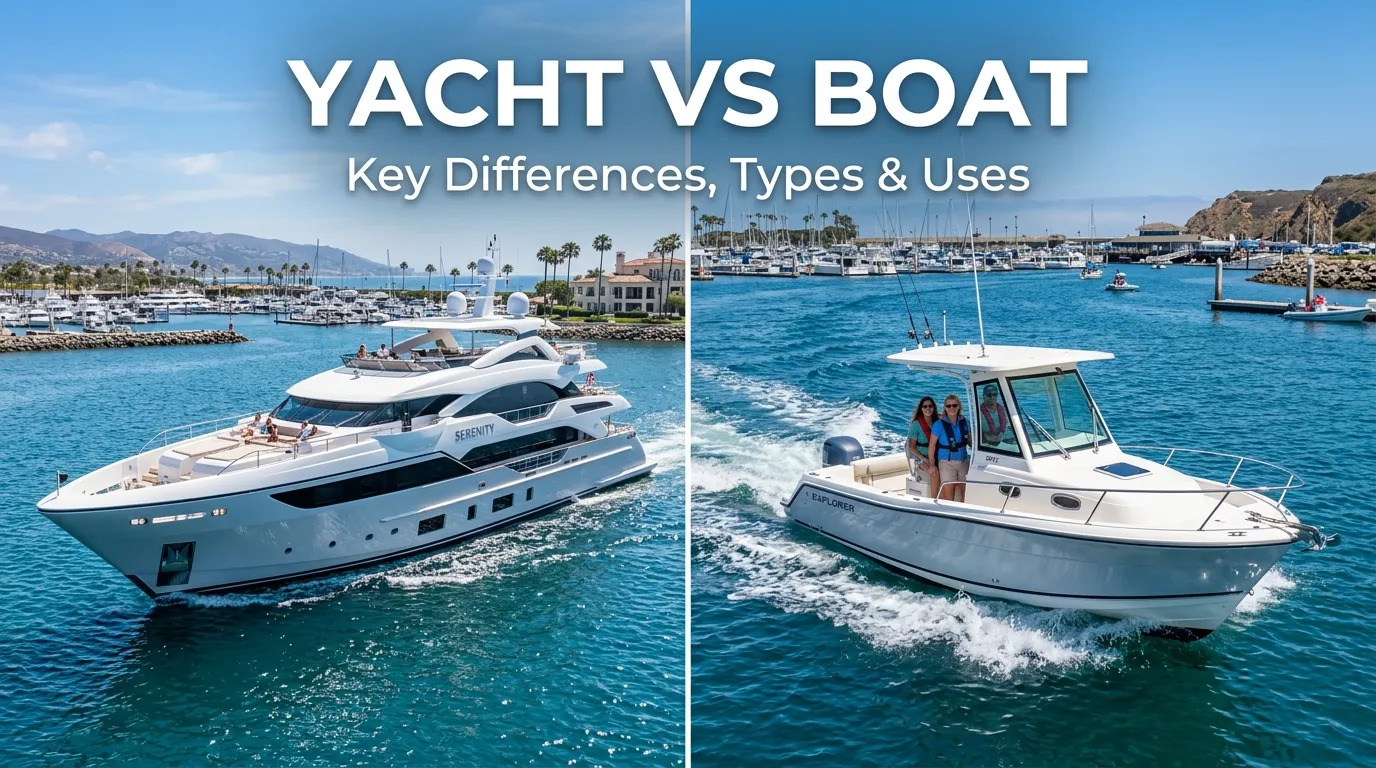
A yacht is a type of recreational boat, but the word usually describes a larger vessel designed for leisure, cruising, comfort, or extended trips.
A boat is the broader term and can describe many watercraft used for fishing, transportation, sports, work, or recreation. There is no universal size that automatically turns a boat into a yacht.
Key Takeaways
- Boat is the broader term for many types of watercraft.
- A yacht is generally a recreational vessel, often larger and more comfortable than an ordinary day boat.
- There is no universal 30-, 33-, or 40-foot rule that legally defines every yacht.
- Yachts can be motor-powered or sail-powered.
- Size, purpose, accommodations, range, and amenities all influence whether people commonly call a vessel a yacht.
What Is a Boat?
A boat is a broad term for a watercraft designed to operate on water. Boats can be used for many different purposes, including fishing, transportation, watersports, recreation, rescue, and commercial work.
That means the word “boat” covers a huge range of vessels.
A small fishing boat, pontoon boat, center-console boat, bowrider, sailboat, cabin cruiser, and even some very large recreational vessels can all be called boats.
Boats also vary greatly in how they are powered. Some use outboard or inboard engines, while others use sails, oars, or other forms of propulsion.
Because “boat” is such a broad category, the word tells you relatively little about a vessel’s size or level of luxury.
What Is a Yacht?
A yacht generally refers to a recreational vessel intended primarily for pleasure, cruising, sailing, racing, entertaining, or extended leisure travel.
Yachts can be sail-powered or motor-powered.
A sailing yacht may have one or more masts and sails, while a motor yacht relies on engines. Some yachts are designed for short recreational outings, while others are built for long-distance cruising and extended stays aboard.
Modern yachts often include features such as cabins, sleeping areas, bathrooms, kitchens or galleys, lounges, large decks, advanced navigation systems, and entertainment spaces.
The important point is that “yacht” is not simply another word for “very large boat.” Size matters, but the vessel’s purpose and design matter too.
Yacht vs Boat: Key Differences
The easiest way to understand yacht vs boat is to compare the factors people normally consider when using these terms.
| Feature | Boat | Yacht |
|---|---|---|
| Meaning | Broad term for watercraft | Usually a recreational type of boat |
| Size | Can be very small to very large | Often larger, but no universal minimum |
| Main purpose | Recreation, fishing, transport, work, sports, etc. | Mainly leisure, cruising, sailing, or racing |
| Comfort | Varies widely | Often emphasizes comfort and accommodation |
| Overnight use | Depends on the design | Common on cruising yachts |
| Propulsion | Engine, sail, oars, or other methods | Motor or sail |
| Amenities | Basic to highly equipped | Often includes cabins and premium amenities |
| Crew | Usually owner-operated on smaller boats | Larger yachts may require professional crew |
1. Size
Size is one of the most obvious differences, but it is not an absolute rule.
You will often see claims that a boat becomes a yacht at 30, 33, or 40 feet. These numbers can be useful as informal industry guidelines, but they should not be treated as a universal definition.
Discover Boating, for example, notes that there is no definitive line between a boat and a yacht. It describes many yachts as roughly 40 to 90 feet while also listing motor-yacht categories beginning at 26 feet.
This creates a gray area.
A well-equipped 35-foot recreational cruiser may be called a yacht by one person and simply a boat by another. The terminology can depend on the vessel’s design, purpose, accommodations, and the boating community using the term.
2. Purpose
Purpose is another major factor.
A fishing boat is built around fishing. A wake boat is designed for watersports. A center-console boat may be used for fishing, cruising, or family recreation.
A yacht, by contrast, is generally associated with leisure and recreational cruising.
For example, a vessel designed to take passengers on extended coastal trips with sleeping cabins, a galley, bathrooms, and comfortable living spaces is more likely to be described as a yacht than a basic open fishing boat of similar length.
3. Comfort and Amenities
Yachts often place more emphasis on onboard comfort.
Depending on the size and type, a yacht may include:
- Private sleeping cabins
- Bathrooms, often called heads
- A galley or full kitchen
- Air conditioning
- Interior lounges
- Dining areas
- Multiple entertainment areas
- Larger outdoor decks
- Advanced navigation electronics
Not every yacht has all these features, and some boats can be surprisingly luxurious.
This is why amenities should be considered alongside size rather than used as a strict definition.
4. Range and Cruising
Many yachts are designed for longer cruising.
A small boat may be ideal for a few hours of fishing, watersports, or a day on a lake. A cruising yacht may be designed to spend several days or longer away from its home marina.
That usually requires additional fuel capacity, navigation equipment, storage, sleeping accommodations, food preparation areas, and systems that support life aboard.
Some specialized yachts, particularly offshore sportfishing yachts, are also designed to travel considerable distances from shore.
5. Cost and Maintenance
Yachts generally cost more to purchase and maintain than smaller recreational boats, but price alone does not determine whether something is a yacht.
A used yacht can cost less than a brand-new high-performance boat. Conversely, a premium 25- or 30-foot boat can cost substantially more than an older recreational cruiser.
Yacht ownership can involve expenses for:
- Dockage
- Insurance
- Fuel
- Engine service
- Hull maintenance
- Electronics
- Cleaning
- Winter storage in some regions
- Repairs and replacement equipment
- Professional crew on larger vessels
The larger and more complex the vessel becomes, the more systems there are to maintain.
6. Crew and Operation
Most small recreational boats are operated directly by their owners.
Larger yachts can be more complicated to handle and maintain. Some owners operate their yachts themselves, while larger vessels may have a captain and additional crew.
Crew requirements therefore relate more to the yacht’s size, complexity, operating area, and owner’s preferences than to the word “yacht” itself.
Is There a Minimum Size for a Yacht?
No single worldwide size automatically makes a vessel a yacht.
This is one of the biggest misconceptions surrounding the yacht vs boat debate.
Some boating and marine-industry sources use approximate size ranges when discussing yachts. For example, Discover Boating says many yachts generally run around 40 to 90 feet, while its broader yacht categories can include vessels beginning at 26 feet.
There is also a specific U.S. Coast Guard regulatory use of the word “yacht.” In one federal regulation, a yacht is defined in the context of Coast Guard Auxiliary activities as a documented or numbered vessel used exclusively for pleasure, or a sailboat used exclusively for pleasure over 16 feet in length.
That definition applies to that regulatory context; it should not be mistaken for a universal rule governing everyday boating language.
So, if someone asks, “Is a 35-foot boat a yacht?” the most accurate answer is: it can be, depending on its design, use, and context.
Is Every Yacht a Boat?
In ordinary language, yes, a yacht can be considered a boat, but not every boat is a yacht.
Think of it as a broad category and a narrower description.
“Boat” describes a wide variety of watercraft.
“Yacht” generally adds information about the vessel’s recreational purpose, scale, design, or level of accommodation.
For example, a small utility boat is a boat, but calling it a yacht would normally sound unusual. A large recreational cruiser, on the other hand, can reasonably be described as both a boat and a yacht.
Are Yachts Only Sailboats?
No.
This is another common misconception.
There are two major categories you will frequently encounter:
Sailing yachts: These use sails as a primary form of propulsion, although many also have engines.
Motor yachts: These rely on engines and may have no sails at all.
Motor yachts can range from relatively compact cruising vessels to enormous luxury vessels with multiple decks and extensive accommodations.
So, the word “yacht” describes more than propulsion. A yacht does not need sails.
Yacht vs Boat vs Ship
“Boat,” “yacht,” and “ship” are not interchangeable in every context.
A boat is a broad everyday term for watercraft.
A yacht generally identifies a recreational vessel, often associated with cruising, sailing, luxury, or extended leisure use.
A ship usually refers to a larger ocean-going or commercial vessel, such as a container ship, cruise ship, or cargo ship.
There are exceptions and gray areas, especially in casual speech and specialized maritime terminology. The size and function of a vessel both influence which word is appropriate.
Common Examples of Boats and Yachts
Here are some simple examples:
Common boats:
- Fishing boat
- Pontoon boat
- Bowrider
- Center-console boat
- Bass boat
- Jon boat
- Ski boat
- Dinghy
- Small sailboat
- Cabin cruiser
Common yachts:
- Motor yacht
- Sailing yacht
- Cruising yacht
- Sportfishing yacht
- Luxury yacht
- Charter yacht
- Superyacht
Notice that some categories overlap. A cabin cruiser, for example, can be large and comfortable enough that people may describe a particular model as a yacht.
Which Term Should You Use?
If you are talking generally about a watercraft, “boat” is almost always safe.
If the vessel is a substantial recreational cruiser designed for leisure, extended trips, or comfortable living aboard, “yacht” may be the more specific term.
When buying or selling a vessel, it is better to focus on its actual specifications rather than the label alone. Look at length, beam, draft, propulsion, range, sleeping capacity, fuel capacity, accommodations, navigation systems, maintenance needs, and intended use.
The word “yacht” can communicate a general category and lifestyle, but the specifications tell you what the vessel can actually do.
Frequently Asked Questions
Is a 30-foot boat a yacht?
It can be, but there is no universal rule saying a 30-foot vessel is automatically a yacht. Some people use “yacht” for recreational boats around this size, especially when they have cabins and cruising amenities. Others would simply call a 30-foot vessel a boat.
Is a 40-foot boat a yacht?
A 40-foot recreational cruiser is commonly described as a yacht, but the label is still not determined by length alone. Purpose, accommodations, design, and intended use can all influence the terminology.
Can a motorboat be a yacht?
Yes. Motor yachts are a well-established category. A yacht does not have to use sails. Many modern yachts rely entirely on engines and are designed for cruising, entertainment, overnight stays, or extended recreational travel.
Why are yachts more expensive than boats?
Yachts often have more space, larger engines, additional navigation systems, cabins, bathrooms, kitchens, generators, air conditioning, and other complex systems. Larger yachts may also require professional crew and more expensive dockage and maintenance. However, there is significant overlap in boat and yacht prices.
What makes a boat a yacht?
There is no single feature that universally transforms a boat into a yacht. In everyday usage, the combination of recreational purpose, size, cruising capability, accommodations, comfort, and amenities usually influences whether people call a vessel a yacht.
Conclusion:
The simplest way to understand yacht vs boat is to remember that “boat” is the broader term, while “yacht” is generally used for a recreational vessel with greater emphasis on cruising, comfort, accommodations, or luxury.
Size is part of the distinction, but there is no universal foot measurement that settles the question.
A 25-foot boat can be highly luxurious, while a 40-foot vessel may be designed primarily for fishing. What matters is the complete picture: purpose, design, size, amenities, cruising capability, and context.
So when someone asks whether a yacht is a boat, the practical answer is yes—a yacht is a type of boat, but most boats are not yachts.

I am Jason Bennett, a confident guy who enjoys good vibes, fun conversations, and meeting interesting people.
I am here on DreamFlirtz.com to make exciting connections and turn simple chats into memorable moments.