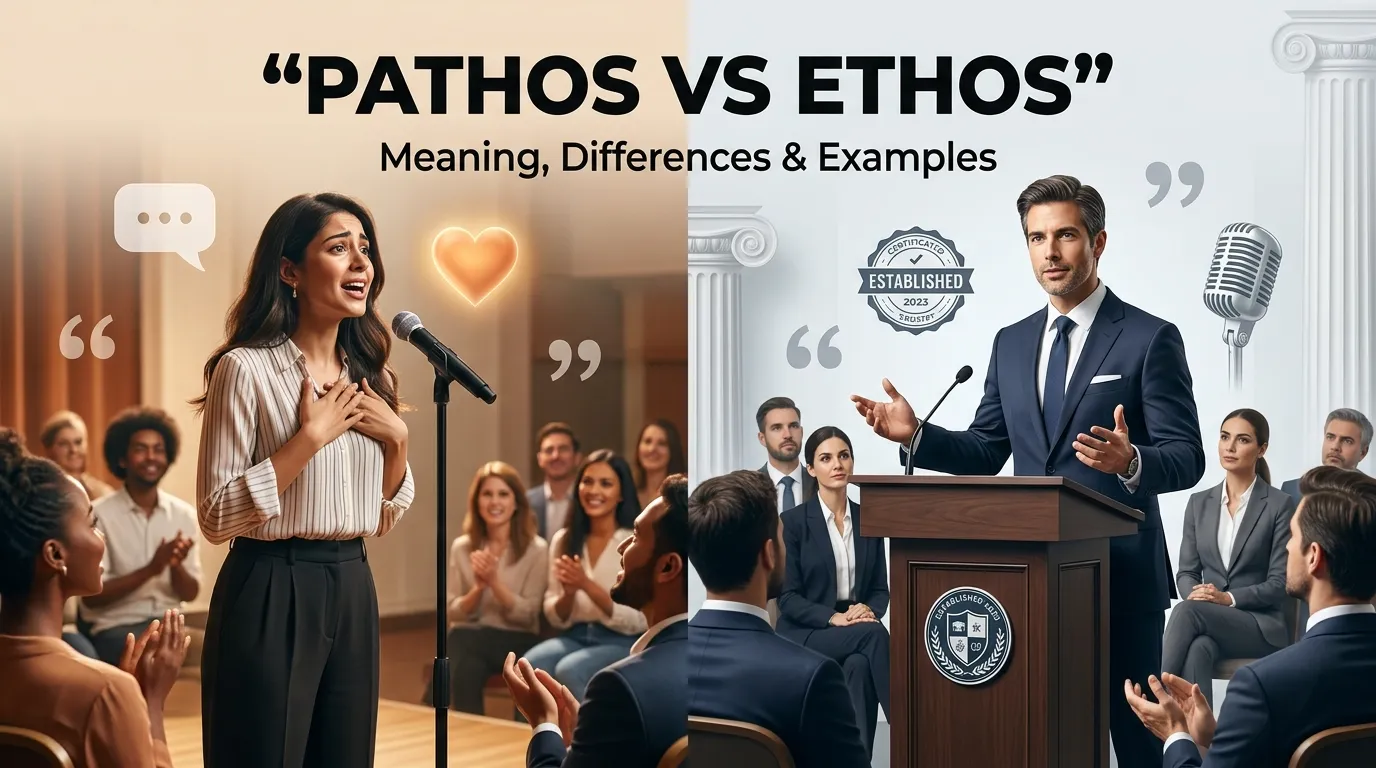
Pathos vs ethos comes down to what a persuasive message asks the audience to respond to. Pathos appeals to emotions, such as sympathy, fear, pride, or joy.
Ethos appeals to credibility and character, encouraging the audience to trust the speaker or writer. Both are rhetorical appeals associated with Aristotle’s approach to persuasion.
Key Takeaways
- Pathos persuades by creating an emotional response.
- Ethos persuades by establishing credibility, character, or trust.
- A personal story can create pathos, while expertise or experience can create ethos.
- A single message can use both ethos and pathos.
- Logos is the third traditional appeal and relies on reasoning and evidence.
What Is Pathos?
Pathos is a rhetorical appeal that connects with an audience’s emotions. A writer or speaker uses pathos when they want people to feel something that supports the message, such as compassion, excitement, sadness, anger, hope, or pride.
For example, imagine an organization asking people to support an animal shelter. Instead of only presenting numbers, its advertisement tells the story of a frightened dog that needs a safe home. The story and emotional language are designed to make viewers feel compassion.
That is pathos.
Educational writing resources commonly describe pathos as an appeal that uses emotional connection, personal stories, vivid descriptions, and emotion-related language to influence an audience.
Examples of Pathos
Here are a few simple examples:
- “Imagine a child spending another night without a safe place to sleep.”
This appeals to sympathy and concern. - “After years of hard work, she finally saw her dream come true.”
This can create feelings of hope or happiness. - “No family should have to choose between buying food and paying the electric bill.”
This appeals to empathy and concern.
Pathos does not always mean sadness. It can involve positive emotions, too. Pride, excitement, love, hope, and joy can all be part of an emotional appeal.
What Is Ethos?
Ethos is a rhetorical appeal based on credibility, character, authority, or trust. It gives the audience a reason to believe that the person making the argument is knowledgeable, trustworthy, experienced, or qualified to discuss the subject.
For example:
“As a registered nutritionist who has worked with families for 15 years, I recommend…”
The speaker establishes relevant expertise. That credibility is an example of ethos.
Ethos can come from professional experience, education, firsthand knowledge, a reputation for fairness, or other details that make a source appear trustworthy in a particular context.
Examples of Ethos
Consider these examples:
- “I have taught high school English for 20 years.”
The speaker establishes relevant experience. - “The report was reviewed by researchers with expertise in environmental science.”
The statement emphasizes qualified sources. - “As someone who has worked in this industry since 2005, I have seen this problem firsthand.”
Personal experience supports credibility.
Ethos is sometimes described as an “appeal to ethics,” but in rhetorical analysis, it is more useful to think of it primarily as an appeal involving credibility and character.
Pathos vs Ethos: Key Differences
The easiest way to remember pathos vs ethos is to ask two different questions:
Pathos: “What does the audience feel?”
Ethos: “Why should the audience trust the speaker or writer?”
| Feature | Pathos | Ethos |
| Main focus | Emotion | Credibility and character |
| Audience response | “I feel…” | “I trust this person…” |
| Common methods | Stories, vivid language, emotional examples | Expertise, experience, authority, trustworthy character |
| Main purpose | Create an emotional connection | Establish trust |
| Example | A story about someone overcoming hardship | A doctor explaining a medical topic |
| Key question | “What should I feel?” | “Why should I believe this source?” |
Both can help make a message persuasive, but they work through different routes.
Pathos Focuses on Emotion
Pathos attempts to affect the audience’s emotional state. A writer may use a personal story, powerful description, emotional vocabulary, or an example that encourages empathy.
For instance:
“After losing everything in the fire, the family had nowhere to go.”
The sentence gives the audience an emotional situation to imagine.
Ethos Focuses on Credibility
Ethos establishes a reason to trust the communicator.
For example:
“After 25 years as a firefighter, I have seen how quickly a small kitchen fire can become dangerous.”
The speaker’s experience is relevant to the subject, which helps establish credibility.
Pathos vs Ethos Examples
Seeing the two appeals in similar situations makes the difference easier to understand.
Example in an Advertisement
Pathos:
“Give an abandoned pet the loving home it deserves.”
The message aims to create compassion and emotional connection.
Ethos:
“Our shelter has provided veterinary care and adoption services to local animals for more than 30 years.”
The message establishes organizational experience and credibility.
An advertisement could use both:
“For 30 years, our shelter has helped abandoned animals find safe homes. Today, one frightened dog is waiting for a family.”
The first sentence builds ethos. The second creates pathos.
Example in a Speech
Imagine a speaker discussing education.
Pathos:
“Every student deserves to walk into a classroom believing that their future matters.”
The statement appeals to hope and shared values.
Ethos:
“I have spent 18 years teaching students in public schools.”
The speaker establishes firsthand experience.
Again, both appeals can exist within the same speech.
Example in an Essay
Suppose a student is writing about the importance of community libraries.
Ethos:
“Librarians help readers find reliable information, research materials, and educational resources.”
This can be strengthened by referring to credible sources or relevant professional expertise.
Pathos:
“For a child who has no books at home, a library can become a quiet place where curiosity has room to grow.”
This uses an emotional image to help readers connect with the subject.
How to Identify Pathos and Ethos in Writing
When analyzing a persuasive passage, look for clues.
Step 1: Ask What the Audience Is Supposed to Feel
If the writer is trying to make readers feel sympathy, fear, excitement, anger, pride, hope, or another emotion, you may be looking at pathos.
Look for:
- Emotional vocabulary
- Personal stories
- Vivid descriptions
- Emotional imagery
- Appeals to shared feelings or values
Step 2: Ask Why the Audience Should Trust the Speaker
If the writer emphasizes expertise, experience, qualifications, fairness, authority, or firsthand knowledge, you may be looking at ethos.
Look for:
- Professional credentials
- Relevant experience
- Firsthand knowledge
- References to expertise
- Statements establishing trustworthiness
Step 3: Consider the Purpose
A passage can contain more than one rhetorical appeal. A university writing resource notes that a text or even a single sentence can contain multiple appeals, so you should not assume that every example belongs to only one category.
Can a Writer Use Ethos and Pathos Together?
Yes. In fact, persuasive communication often combines rhetorical appeals rather than relying on only one.
Consider this example:
“As a volunteer physician who has worked in rural clinics for more than a decade, I have seen how difficult it can be for families to access basic care. No parent should have to drive for hours simply to get a sick child examined.”
The first part establishes ethos through relevant experience.
The second part uses pathos by appealing to concern for parents and children.
This combination can create a stronger connection because the audience receives both a reason to trust the speaker and an emotional reason to care about the issue.
Ethos, Pathos, and Logos: How They Relate
Ethos and pathos are two of the three traditional rhetorical appeals associated with Aristotle. The third is logos, which appeals to reasoning, evidence, and logic.
A simple way to remember them is:
- Ethos = credibility
- Pathos = emotion
- Logos = logic
Imagine someone arguing that a school should add more after-school programs.
Ethos:
“I have worked with students and youth programs for more than 10 years.”
Pathos:
“Every child deserves a safe place to learn and connect after the school day ends.”
Logos:
“Attendance records show that the existing program serves more students than its current capacity allows.”
The three approaches address different parts of persuasion.
Common Mistakes to Avoid
One common mistake is assuming that ethos simply means being ethical. In rhetorical analysis, ethos is more specifically connected to the speaker’s character, credibility, and ability to establish trust.
Another mistake is thinking that pathos means only sadness. Emotional appeals can involve many emotions, including happiness, pride, fear, anger, hope, and compassion.
It is also important not to confuse logos with ethos. A statement can come from an expert and still use logos if it provides evidence and reasoning. Likewise, a personal story may establish ethos while also creating pathos.
The key is to examine how the language works on the audience, not just the topic being discussed.
FAQs:
What is the difference between pathos and ethos?
Pathos appeals primarily to the audience’s emotions, while ethos appeals to credibility, character, and trust. Pathos asks the audience to feel something, whereas ethos gives the audience a reason to trust the person making the argument. Both can appear together in the same speech, advertisement, essay, or other persuasive message.
What is an example of pathos?
A sentence such as “Imagine a lonely child waiting every day for someone to call their name” uses pathos because it creates an emotional image intended to make the audience feel sympathy or concern. Personal stories, vivid descriptions, and emotionally charged language are common ways writers create pathos.
What is an example of ethos?
An example of ethos is: “As a licensed engineer with 20 years of experience designing bridges, I recommend regular structural inspections.” The speaker refers to relevant expertise, giving the audience a reason to consider the advice credible.
Can one sentence contain both ethos and pathos?
Yes. A statement can establish credibility while also creating an emotional response. For example, an experienced emergency worker might describe a dangerous situation from firsthand experience while using vivid language that makes the audience feel concern. Rhetorical appeals can overlap rather than existing as completely separate categories.
Are ethos and pathos used in persuasive writing?
Yes. Writers use ethos to establish trust and pathos to create an emotional connection with readers. They may also use logos to provide reasoning and evidence. Which appeal receives more attention depends on the writer’s purpose, audience, and rhetorical situation.
Conclusion:
The main difference in pathos vs ethos is simple: pathos appeals to emotion, while ethos appeals to credibility and character.
If a writer wants the audience to feel compassion, excitement, fear, hope, or another emotion, pathos may be at work. If the writer wants the audience to trust their knowledge, experience, or character, the appeal is more closely related to ethos.
Understanding this difference makes it easier to analyze essays, speeches, advertisements, and everyday persuasive messages. Once you can ask “What is the audience being encouraged to feel?” and “Why should the audience trust the speaker?”, identifying pathos and ethos becomes much easier.