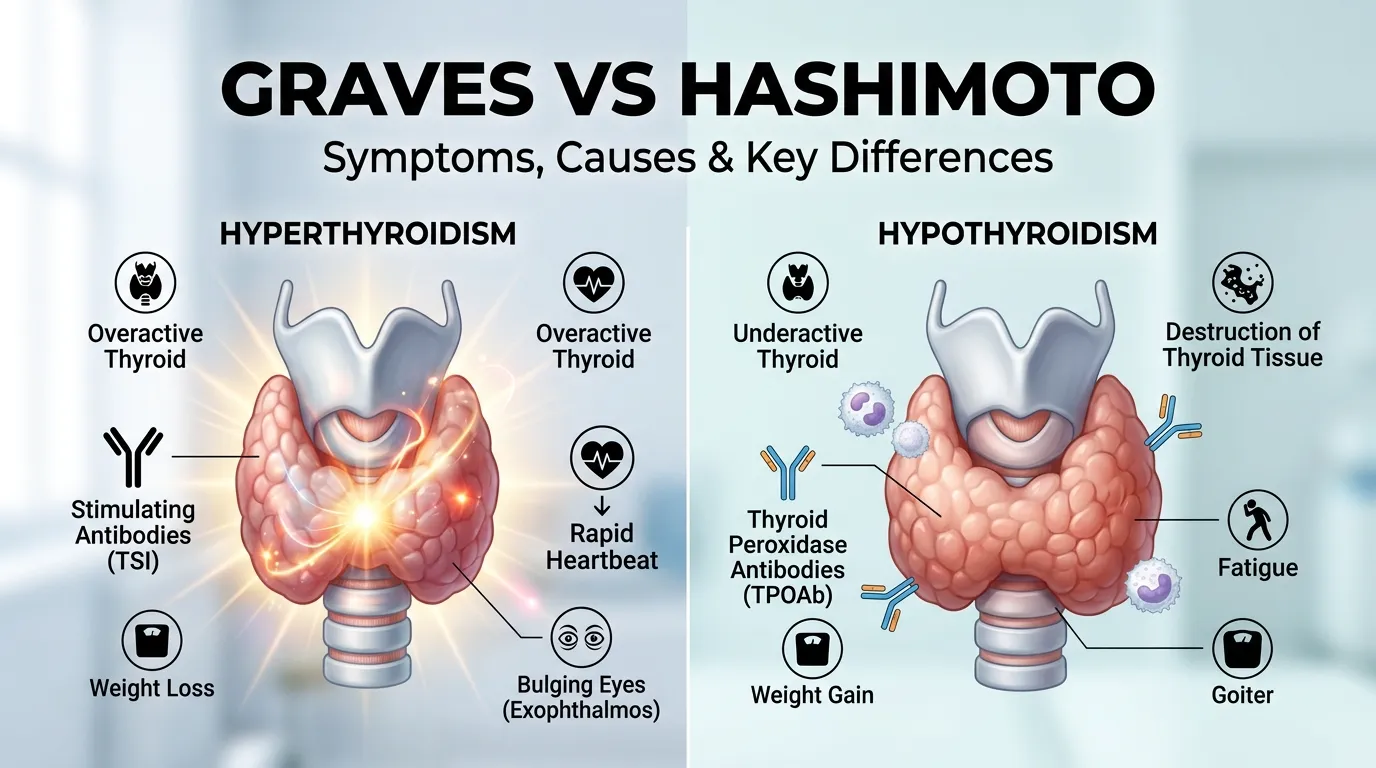
Graves disease and Hashimoto’s thyroiditis are both autoimmune thyroid disorders, but they usually affect thyroid function in opposite ways.
Graves disease stimulates the thyroid and commonly causes hyperthyroidism, while Hashimoto’s gradually damages the thyroid and commonly causes hypothyroidism.
Blood tests, antibody testing, symptoms, and sometimes imaging help doctors distinguish between them.
Key Takeaways
- Graves disease usually causes an overactive thyroid and too much thyroid hormone.
- Hashimoto’s thyroiditis commonly damages the thyroid and eventually causes an underactive thyroid.
- Graves disease is associated mainly with TSI/TRAb antibodies, while Hashimoto’s commonly involves TPO and thyroglobulin antibodies.
- Symptoms can overlap, so doctors use thyroid function and antibody tests rather than symptoms alone.
- Treatment is different: Graves may involve antithyroid medicines, radioactive iodine, or surgery, while hypothyroidism from Hashimoto’s is generally treated with thyroid hormone replacement.
Graves vs Hashimoto: What Is the Main Difference?
The simplest way to understand Graves vs Hashimoto is to look at what the immune system does to the thyroid.
Graves disease causes antibodies to stimulate the thyroid. The gland receives signals that encourage it to produce too much thyroid hormone, resulting in hyperthyroidism.
Hashimoto’s thyroiditis works differently. The immune system produces antibodies that contribute to inflammation and damage of thyroid tissue. Over time, the thyroid may no longer produce enough hormones, leading to hypothyroidism.
Both conditions can cause an enlarged thyroid, fatigue, and other nonspecific symptoms. That is why symptoms alone are not enough to determine which condition a person has.
| Feature | Graves Disease | Hashimoto’s Thyroiditis |
|---|---|---|
| Autoimmune condition | Yes | Yes |
| Usual thyroid state | Hyperthyroidism | Hypothyroidism |
| Main effect | Stimulates thyroid | Damages thyroid |
| Common antibodies | TSI/TRAb | TPO/Tg antibodies |
| Typical symptoms | Heat intolerance, weight loss, rapid heartbeat, tremor | Cold intolerance, fatigue, weight gain, constipation |
| Eye disease | Can occur, including Graves’ eye disease | Not typical |
| Common treatment | Antithyroid drugs, radioactive iodine, or surgery | Levothyroxine when hypothyroidism is present |
Graves Disease Explained
Graves disease is an autoimmune disorder in which antibodies stimulate receptors on thyroid cells. These antibodies can act similarly to thyroid-stimulating hormone and cause the thyroid to produce excessive amounts of thyroid hormones.
It is the most common cause of hyperthyroidism in the United States.
Common Graves Disease Symptoms
Because Graves commonly causes excess thyroid hormone, symptoms tend to reflect an accelerated metabolism. Possible symptoms include:
- Weight loss despite normal or increased appetite
- Fast or irregular heartbeat
- Feeling nervous or irritable
- Trouble sleeping
- Shaky hands
- Muscle weakness
- Sweating
- Heat intolerance
- Frequent bowel movements
- Enlarged thyroid or goiter
Graves can also affect the eyes. Graves’ eye disease may cause gritty or irritated eyes, swelling around the eyes, light sensitivity, pressure, blurred or double vision, or bulging eyes.
Not everyone with Graves develops eye disease, and the severity of eye symptoms can vary.
How Graves Disease Is Diagnosed
Doctors generally combine symptoms and physical examination findings with blood tests. Tests can measure TSH, T4, and T3, while antibody testing can look for thyroid-stimulating immunoglobulin or TSH receptor antibodies.
If the diagnosis remains uncertain, doctors may use radioactive iodine uptake testing, a thyroid scan, or Doppler ultrasound in appropriate situations.
Hashimoto’s Thyroiditis Explained
Hashimoto’s thyroiditis, also called chronic lymphocytic or autoimmune thyroiditis, is another autoimmune thyroid disorder.
Instead of stimulating the thyroid, the immune response damages thyroid tissue. The process often develops slowly, and some people have thyroid antibodies before they develop noticeable symptoms or abnormal thyroid hormone levels.
Hashimoto’s is the most common cause of hypothyroidism in the United States.
Common Hashimoto Symptoms
As thyroid function falls, symptoms can include:
- Fatigue
- Weight gain
- Increased sensitivity to cold
- Constipation
- Dry skin
- Dry or thinning hair
- Muscle or joint aches
- Depression or low mood
- Difficulty exercising
- Heavy or irregular menstrual periods
Some people also develop a goiter, which can cause pressure or discomfort in the neck or difficulty swallowing.
How Hashimoto’s Is Diagnosed
Doctors may check TSH and thyroid hormone levels, along with thyroid antibodies. TPO antibodies are particularly associated with Hashimoto’s, although thyroglobulin antibodies can also be present.
An ultrasound may sometimes be useful, particularly when the diagnosis is uncertain or the thyroid is enlarged.
Importantly, having thyroid antibodies does not automatically mean that someone needs thyroid hormone treatment. Treatment decisions depend largely on actual thyroid function and the clinical situation.
How Blood Tests Differ
Blood testing is one of the most useful ways doctors distinguish Graves disease from Hashimoto’s.
With typical Graves disease, TSH is low while T4 and/or T3 are elevated, reflecting hyperthyroidism. TSI or TRAb testing can provide additional evidence that Graves is the cause.
With established hypothyroidism from Hashimoto’s, TSH is usually elevated, while free T4 may be low. TPO and/or thyroglobulin antibodies can support the diagnosis.
These patterns are useful, but laboratory results need to be interpreted in context. A single thyroid test should not be used to self-diagnose a thyroid disorder.
Can Hashimoto’s Cause Hyperthyroidism?
Yes, but usually temporarily.
In some cases, inflammation from Hashimoto’s can damage thyroid cells and release stored thyroid hormone into the bloodstream. This can produce a temporary period of thyrotoxic or hyperthyroid symptoms before thyroid function becomes normal or eventually underactive.
This is different from Graves disease, where antibodies actively stimulate the thyroid to produce excessive hormone.
That distinction matters because the treatments are not the same. Antithyroid medicines are used for an overactive thyroid such as Graves disease, but they do not treat the temporary hormone release caused by destructive thyroiditis.
How Treatment Differs
Graves Disease Treatment
Treatment aims to control excessive thyroid hormone production and prevent complications.
Depending on the person’s situation, treatment can include:
- Antithyroid medication, commonly methimazole
- Radioactive iodine
- Thyroid surgery
- Beta-blockers for symptoms such as rapid heartbeat and tremors
The appropriate approach depends on factors such as symptoms, age, pregnancy status, thyroid size, eye disease, other health considerations, and personal circumstances.
Hashimoto’s Treatment
Hashimoto’s does not always require immediate medication. If thyroid antibodies are present but thyroid hormone levels remain normal, doctors may monitor thyroid function rather than automatically prescribe thyroid hormone.
When Hashimoto’s causes clinical hypothyroidism, the standard treatment is levothyroxine, a thyroid hormone replacement medication. The dose is adjusted according to thyroid function testing and the individual’s needs.
Many people with established hypothyroidism caused by Hashimoto’s require long-term thyroid hormone replacement.
Can You Have Both Graves and Hashimoto’s?
Graves disease and Hashimoto’s are distinct autoimmune thyroid conditions, but autoimmune thyroid disease can be complex. A person’s thyroid function can also change over time, and Hashimoto’s may have a temporary thyrotoxic phase.
Because of this, someone who has changing thyroid test results or symptoms should be evaluated rather than assuming that one diagnosis explains every result.
A doctor may consider thyroid hormone levels, antibody patterns, symptoms, examination findings, medication history, and sometimes imaging when determining the cause.
When to Talk With a Doctor
Consider discussing thyroid symptoms with a healthcare professional if you have unexplained changes such as persistent fatigue, weight changes, rapid heartbeat, tremors, unusual sensitivity to heat or cold, constipation, sleep problems, or menstrual changes.
Eye symptoms such as new double vision, significant eye pain, vision changes, or prominent swelling around the eyes also deserve medical attention, particularly in someone with suspected or known Graves disease.
Thyroid disorders can resemble other health conditions, so proper testing is more reliable than trying to identify Graves disease or Hashimoto’s from symptoms alone.
Frequently Asked Questions
What is the main difference between Graves disease and Hashimoto’s?
Graves disease usually causes the thyroid to become overactive because stimulating antibodies tell it to produce excess thyroid hormone. Hashimoto’s gradually damages thyroid tissue and commonly leads to an underactive thyroid. Both are autoimmune disorders, but their typical effects on thyroid function are opposite.
Can Hashimoto’s cause hyperthyroidism?
Hashimoto’s can sometimes cause a temporary hyperthyroid or thyrotoxic phase when inflammation releases stored thyroid hormone. This does not mean the thyroid is being continuously stimulated in the same way as in Graves disease. Thyroid tests and the clinical picture help doctors determine the cause.
Which antibodies are associated with Graves disease?
Graves disease is particularly associated with TSI and TRAb, antibodies that target the TSH receptor and stimulate thyroid activity. Doctors may use these tests when determining whether hyperthyroidism is caused by Graves disease.
Which antibodies are associated with Hashimoto’s?
Hashimoto’s is commonly associated with thyroid peroxidase (TPO) antibodies and may also involve thyroglobulin (Tg) antibodies. Antibody results are interpreted together with thyroid hormone levels and other clinical information.

I am Jason Bennett, a confident guy who enjoys good vibes, fun conversations, and meeting interesting people.
I am here on DreamFlirtz.com to make exciting connections and turn simple chats into memorable moments.