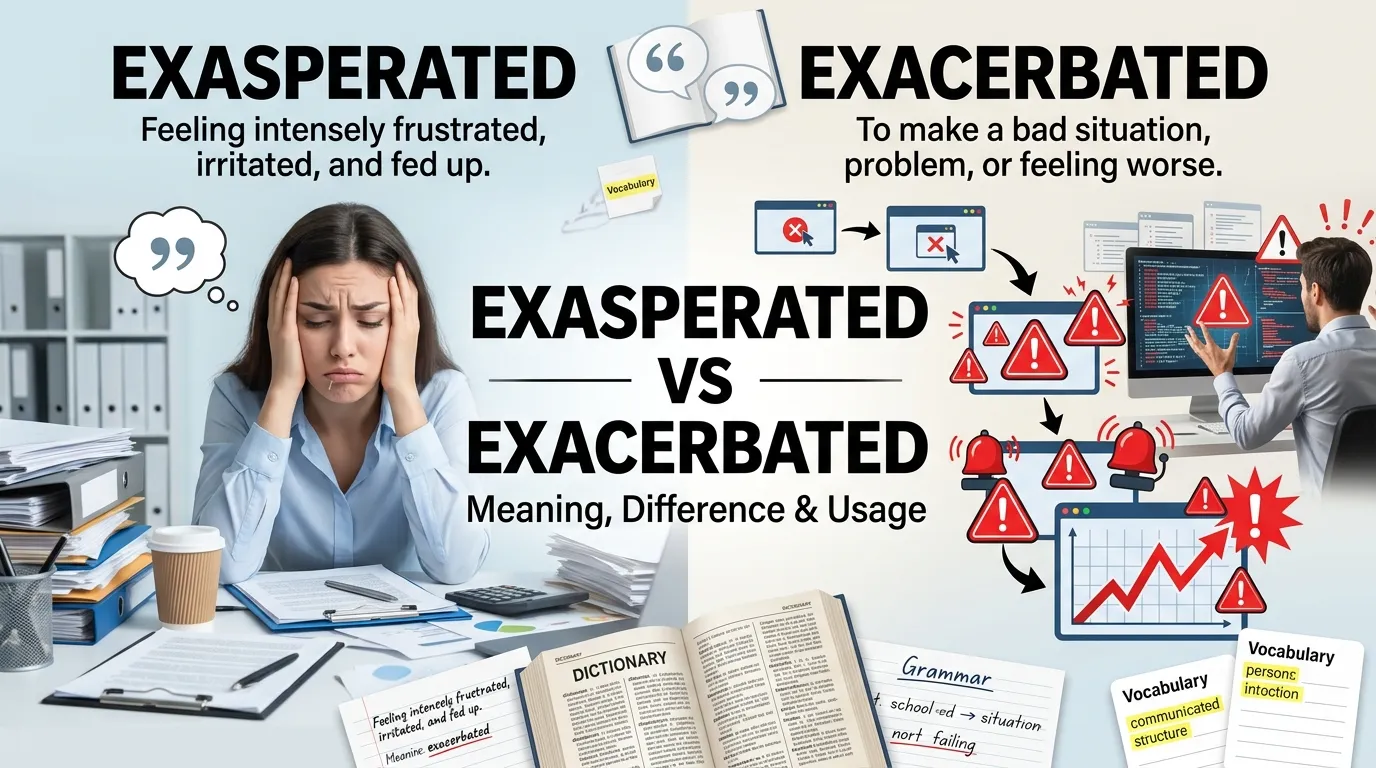
Exasperated means extremely annoyed, frustrated, or irritated, usually describing a person’s emotional state.
Exacerbated means made something that was already bad even worse. In simple terms, you can be exasperated by a problem, while an action can exacerbate the problem. The words sound similar but have different meanings and uses.
Key Takeaways
- Exasperated describes a person who is very annoyed, frustrated, or irritated.
- Exacerbated means that an existing problem or negative condition has become worse.
- You might be exasperated by delays, while those delays may have exacerbated the problem.
- “Exasperated the situation” is usually the wrong choice when you mean “made the situation worse.”
- Remember: people get exasperated; problems get exacerbated.
Exasperated vs Exacerbated: The Main Difference
The easiest way to understand exasperated vs exacerbated is to focus on what is being affected.
Exasperated is about a person’s emotional reaction. It means someone has become very annoyed, frustrated, or irritated. Cambridge defines exasperate as making someone very annoyed, particularly when they cannot easily solve the problem causing the frustration.
Exacerbated, on the other hand, is about making an existing problem, condition, or negative situation worse. Cambridge defines exacerbate as making something that is already bad even worse.
Compare these two sentences:
- The constant delays exasperated the customers.
- The constant delays exacerbated the scheduling problem.
In the first sentence, the customers become frustrated. In the second, the problem becomes more serious.
This distinction is the key to using both words correctly.
What Does Exasperated Mean?
Exasperated is an adjective that describes someone who is extremely annoyed, frustrated, or irritated.
For example:
She was exasperated by the endless phone calls.
The sentence tells us how she felt. The repeated calls caused frustration and annoyance.
Cambridge’s American Dictionary describes exasperate as causing anger or extreme annoyance in someone.
You will often see exasperated followed by by, with, or at:
- He was exasperated by the repeated mistakes.
- I became exasperated with the slow service.
- She was exasperated at the constant interruptions.
Exasperated in a Sentence
Here are some natural examples:
- I was exasperated by the website’s constant errors.
- The teacher looked exasperated after answering the same question five times.
- She became exasperated with her roommate’s repeated excuses.
- The customer was exasperated by the long wait.
- He sounded exasperated during the phone call.
In each example, a person experiences strong frustration.
Common Uses of Exasperated
The word works especially well when someone has been dealing with an annoying situation for some time.
For example:
“After waiting two hours, Maria was exasperated.”
The emphasis is on Maria’s emotional response.
You can also use exasperating to describe something that causes this reaction:
“The two-hour wait was exasperating.”
So:
- Exasperated = how a person feels.
- Exasperating = something that causes intense frustration.
Cambridge similarly defines exasperating as annoying, particularly when a person feels unable to solve the problem.
What Does Exacerbated Mean?
Exacerbated is the past tense and past participle of exacerbate.
It means made something worse, more serious, or more severe.
For example:
The heavy rain exacerbated the flooding.
The rain did not necessarily create the entire problem. Instead, it made an existing problem worse.
Other examples include:
- Lack of sleep exacerbated his stress.
- The delay exacerbated the scheduling problem.
- Dust exacerbated her allergy symptoms.
- Poor communication exacerbated the conflict.
- The heat exacerbated the drought.
Cambridge gives examples involving allergies, tense relationships, workplace problems, and other conditions that become worse.
Exacerbated in a Sentence
A useful sentence pattern is:
Something + exacerbated + an existing problem.
For example:
The lack of communication exacerbated the disagreement.
The disagreement already existed. The lack of communication made it worse.
Another example:
Skipping rest exacerbated his injury.
The injury was already present. The action increased the severity of the problem.
This is why exacerbated often appears with words such as:
- problem
- situation
- conflict
- symptoms
- injury
- condition
- crisis
- tension
- pain
- shortage
- damage
Exasperated vs Exacerbated: Side-by-Side Comparison
| Word | Meaning | Usually Describes | Example |
| Exasperated | Extremely annoyed or frustrated | A person’s emotional state | She was exasperated by the delay. |
| Exacerbated | Made something worse | A problem, condition, or situation | The delay exacerbated the problem. |
A quick comparison makes the difference easier to see:
The noisy construction exasperated the residents.
The residents became very annoyed.
The construction exacerbated the traffic problem.
The traffic problem became worse.
The same event can therefore exasperate people and exacerbate problems.
How to Know Which Word to Use
When you’re unsure about exasperated vs exacerbated, ask yourself one simple question:
Am I talking about someone’s frustration, or am I talking about something becoming worse?
Use Exasperated for People and Feelings
Use exasperated when someone is experiencing strong annoyance or frustration.
Correct:
The manager was exasperated by the repeated interruptions.
Incorrect for this meaning:
The manager was exacerbated by the repeated interruptions.
The second sentence does not communicate the intended emotional state.
A useful pattern is:
Person + is/was/felt + exasperated + by/with/at + cause.
Examples:
- I was exasperated by the delay.
- She felt exasperated with the situation.
- They were exasperated at the constant complaints.
Use Exacerbated for Problems and Conditions
Use exacerbated when something makes an existing negative situation worse.
Correct:
The delay exacerbated the scheduling problem.
Correct:
The cold weather exacerbated the road conditions.
Correct:
His lack of preparation exacerbated the situation.
The focus is not on someone’s emotional response. The focus is on the increased severity of a problem.
Common Mistakes With Exasperated and Exacerbated
One of the most common errors is using exasperated when you mean exacerbated.
For example:
Incorrect:
The mistake exasperated the problem.
Better:
The mistake exacerbated the problem.
Why? Because the mistake made the problem worse.
Another common mistake is switching the words when describing a person’s frustration.
Incorrect for the intended meaning:
She was exacerbated by the constant noise.
Correct:
She was exasperated by the constant noise.
The first sentence suggests that something happened to “her” in the sense of worsening a condition, while the intended meaning is that she became extremely annoyed.
LanguageTool and Washington State University’s Common Errors in English Usage both identify this distinction: exasperate centers on irritation, while exacerbate means making a situation worse.
Can Both Words Be Used in the Same Situation?
Yes. This is one of the easiest ways to understand the distinction.
Imagine a customer has been waiting for hours because of a computer system failure.
You could write:
The computer failure exacerbated the company’s service problems and exasperated the waiting customers.
Both words are correct because they describe two different effects.
- The service problems became worse → exacerbated
- The customers became extremely frustrated → exasperated
This distinction is especially useful in professional writing because it lets you describe the problem and the human reaction separately.
Easy Memory Trick
Try this simple rule:
Exasperated = Emotion
Think:
Exasperated → annoyed person
If someone has reached the end of their patience, they may be exasperated.
Exacerbated = Worse
Think:
Exacerbated → worsening problem
If an action increases the severity of an existing problem, it exacerbates that problem.
You can also remember this sentence:
People become exasperated; problems become exacerbated.
This is a useful shortcut, although the full meanings are a little broader than that simple rule. Dictionary definitions show that exasperate concerns intense annoyance, while exacerbate concerns making something already bad worse.
FAQs:
Is it exasperated or exacerbated?
Both words are correct, but they have different meanings. Use exasperated when someone is extremely annoyed or frustrated. Use exacerbated when something makes an existing problem, condition, or situation worse. For example, “She was exasperated by the delay,” but “The delay exacerbated the problem.”
Can a situation be exasperated?
Usually, exacerbated is the appropriate word when you mean that a situation has become worse. For example, “The misunderstanding exacerbated the situation.” Exasperated normally describes a person who has become very annoyed or frustrated.
Can a person be exacerbated?
When describing a person’s emotional reaction, exasperated is normally the correct word. You can say, “He was exasperated by the constant interruptions.” Exacerbated is generally used when something has been made worse, such as a problem, condition, symptom, or situation.
Are exasperated and exacerbated interchangeable?
No. Although the words look and sound similar, their primary modern meanings are different. Exasperated refers to intense annoyance or frustration, while exacerbated means made worse or more severe. Replacing one with the other can change the meaning of a sentence.
What is an easy example of both words?
Consider this sentence:
The repeated delays exasperated the passengers and exacerbated the travel problem.
The passengers became frustrated, so they were exasperated. The travel problem became worse, so it was exacerbated.
Conclusion:
The difference between exasperated vs exacerbated becomes much easier when you focus on the result.
Exasperated describes a person who is extremely annoyed, frustrated, or irritated. Exacerbated describes something that has been made worse, such as a problem, condition, conflict, or situation.
When writing, ask yourself whether you are describing a person’s frustration or the worsening of a problem. If it is frustration, choose exasperated. If something has become worse, choose exacerbated.
People get exasperated. Problems get exacerbated.