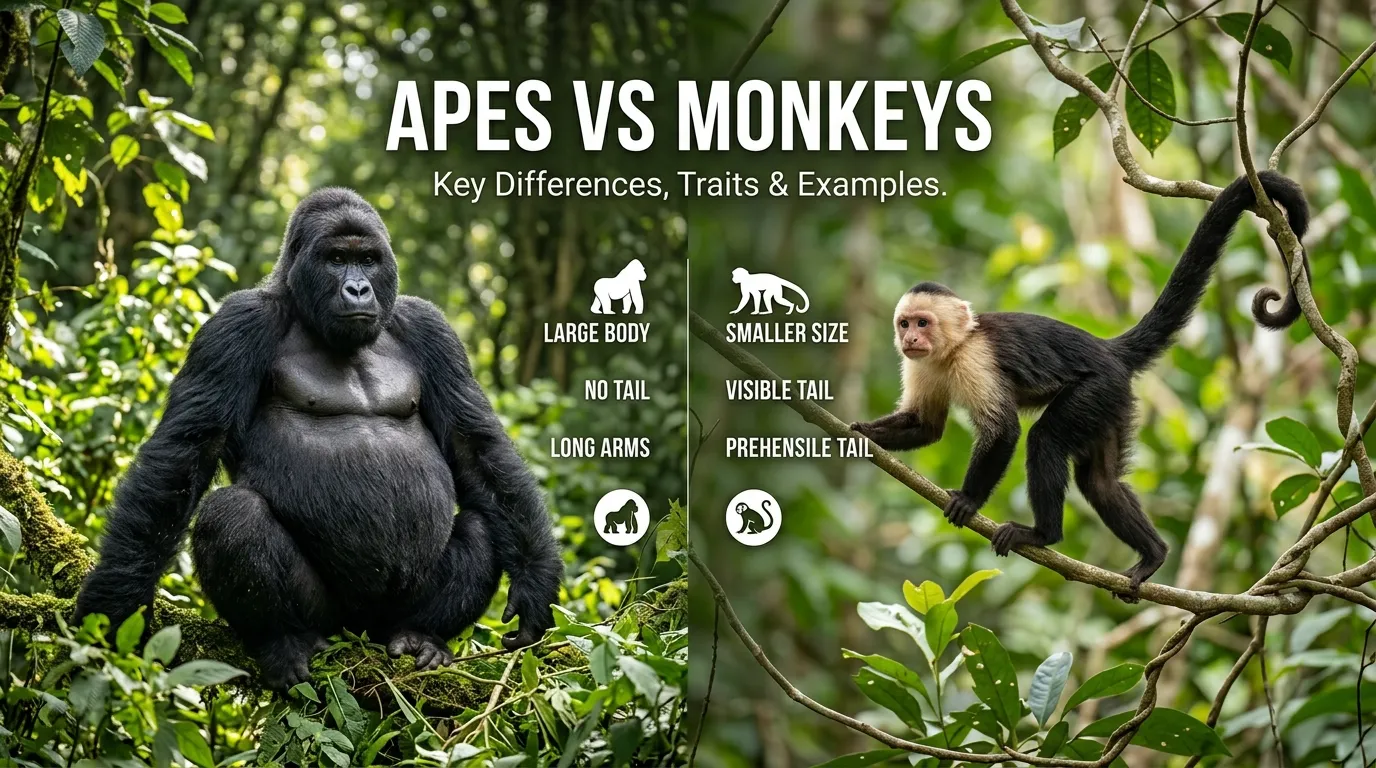
Apes and monkeys are both primates, but they are different groups. Most monkeys have tails, while living apes have no external tails.
Apes generally have broader chests, more flexible shoulders, and larger brains relative to body size. Humans, chimpanzees, gorillas, orangutans, bonobos, and gibbons are apes, while monkeys include Old World and New World species.
Key Takeaways
- Apes do not have external tails; most monkeys do.
- Apes generally have broader chests, longer arms, and highly mobile shoulders.
- Monkeys include Old World and New World monkeys.
- Humans are great apes, not monkeys.
- Tail presence is a useful clue, but it is not a perfect rule because some monkeys have extremely short or absent tails.
Apes vs Monkeys: Quick Comparison
At first glance, apes and monkeys can look very similar. Both have hair, grasping hands, forward-facing eyes, and other features associated with primates. But they belong to different branches of the primate family tree.
| Feature | Apes | Monkeys |
| External tail | None | Most have one |
| Body build | Generally broader and more robust | Generally more varied and often smaller |
| Chest | Broad and relatively flat | Generally narrower |
| Shoulders | Highly flexible | Generally less specialized for suspension |
| Arms | Often long relative to legs | Usually more similar in length |
| Movement | Climbing, swinging, walking, and other forms | Often quadrupedal climbing or running |
| Brain-to-body ratio | Generally larger | Generally smaller |
| Examples | Humans, gorillas, chimps, orangutans, gibbons | Baboons, macaques, capuchins, tamarins, spider monkeys |
These are broad tendencies rather than rules that perfectly describe every species. For example, some monkeys have very short or absent external tails.
What Is an Ape?
An ape is a tailless primate belonging to the group commonly called the apes. Living apes include humans, chimpanzees, bonobos, gorillas, orangutans, gibbons, and siamangs.
Apes are divided into great apes and lesser apes.
Great Apes
The great apes are:
- Humans
- Chimpanzees
- Bonobos
- Gorillas
- Orangutans
Great apes generally have larger bodies and brains than lesser apes, although humans are unusual in several physical characteristics.
The Smithsonian’s National Zoo specifically identifies orangutans, bonobos, chimpanzees, gorillas, and humans as great apes.
Lesser Apes
The lesser apes are gibbons and siamangs.
Despite their smaller size, gibbons are apes rather than monkeys. They have no external tails and have very long arms and specialized shoulders that help them move through trees by swinging beneath branches.
This is important because size alone cannot tell you whether a primate is an ape.
What Is a Monkey?
“Monkey” is a common biological term used for two major groups: New World monkeys and Old World monkeys.
Old World Monkeys
Old World monkeys are native to Africa and Asia. Examples include:
- Baboons
- Macaques
- Colobus monkeys
- Guenons
- Mandrills
Their tails vary considerably. Some are long, while others are short or even absent. Macaques provide a good example: some species have long tails, while others have short or completely absent external tails.
New World Monkeys
New World monkeys are native to Central and South America. Examples include:
- Capuchins
- Spider monkeys
- Howler monkeys
- Squirrel monkeys
- Marmosets
- Tamarins
Some New World monkeys have prehensile tails. These tails can grasp branches and provide support during movement. Spider monkeys and howler monkeys are among the groups with this adaptation.
Apes vs Monkeys: Key Differences
1. Tails
The easiest visual clue is the tail.
Living apes have no external tail. Most monkeys, in contrast, have tails. This makes a tail a useful first clue when identifying a primate.
However, saying “every monkey has a tail” would be inaccurate.
Some monkeys have extremely short tails, and some macaque species lack an external tail altogether. The Celebes crested macaque, for example, has only a tiny tail.
So the better rule is:
No external tail = likely an ape, but you should consider other characteristics too.
2. Body Shape and Size
Apes are generally more robust than monkeys. They tend to have broader chests and body structures adapted for climbing, hanging, and other forms of movement.
Monkeys have greater variation in body size and shape. Some are tiny, such as pygmy marmosets, while others are considerably larger.
This means size alone is not a reliable identification method. A small gibbon is still an ape, while a relatively large baboon is still a monkey.
3. Arms and Shoulders
One of the most important anatomical differences involves the shoulders.
Apes generally have highly mobile shoulder joints and relatively long arms. These features are especially useful for climbing and suspensory movement.
Gibbons are famous for brachiation, or swinging beneath branches using their arms. Their long arms and specialized shoulders make this movement particularly effective.
Monkeys can also climb, leap, and even use suspensory movements, so this is not an absolute dividing line. Instead, it is part of the larger anatomical pattern separating apes from monkeys.
4. Movement
Many monkeys spend substantial time moving on all four limbs. Their body structure is often well suited to running along branches or traveling across the ground.
Apes have a wider range of movement. Depending on the species, they may climb, swing through trees, walk on the ground, or move upright for periods of time.
Chimpanzees and gorillas, for example, use terrestrial movement extensively, while orangutans spend much of their lives in trees. Gibbons are highly specialized for swinging through forest canopies.
5. Intelligence and Tool Use
Apes are generally associated with more complex cognitive abilities, including sophisticated problem-solving, learning, communication, and tool use.
That does not mean monkeys are unintelligent.
Many monkey species demonstrate impressive learning, social behavior, communication, memory, and problem-solving skills. The difference is better understood as a broad evolutionary pattern rather than a simple “smart versus dunb” division.
Apes generally have larger brains relative to their body size, and their cognitive abilities include complex learned behaviors.
6. Classification and Evolution
Both groups belong to the order Primates, but apes and monkeys occupy different branches within the broader primate family tree.
New World monkeys form one major monkey lineage, while Old World monkeys are more closely related to apes than New World monkeys are.
This is one reason the phrase “apes are just large monkeys” is misleading. Apes have their own evolutionary history and distinctive anatomical characteristics.
Are Humans Apes or Monkeys?
Humans are apes.
More specifically, humans are great apes and belong to the same broad group as chimpanzees, bonobos, gorillas, and orangutans. The Smithsonian also explicitly includes humans among the great apes.
Humans do share many characteristics with monkeys because both groups are primates. But biologically, humans are not classified as monkeys.
Our lack of an external tail is one obvious feature. Our anatomy, genetics, brain structure, and evolutionary relationships provide much stronger evidence for our classification as apes.
Common Apes and Monkeys
Here are some familiar examples:
Apes:
- Human
- Chimpanzee
- Bonobo
- Gorilla
- Orangutan
- Gibbon
- Siamang
Monkeys:
- Baboon
- Macaque
- Capuchin
- Spider monkey
- Howler monkey
- Squirrel monkey
- Marmoset
- Tamarin
A common source of confusion is the gibbon. Because gibbons are small and spend much of their time in trees, people sometimes assume they are monkeys. They are actually lesser apes.
Why the Tail Test Is Useful but Not Perfect
The tail is probably the fastest way to begin distinguishing an ape from a monkey, but it should not be treated as an absolute biological test.
All living apes lack external tails, while most monkeys have them. But monkeys show considerable tail diversity. Some macaques have very short tails or no external tail, and different monkey groups have tails adapted for different purposes.
Some New World monkeys even have prehensile tails that function almost like an additional grasping aid.
Therefore, when identifying an unfamiliar primate, consider several features together: tail, body shape, shoulders, arms, movement, and overall anatomy.
FAQs:
Are apes and monkeys the same?
No. Apes and monkeys are both primates, but they are different groups. Living apes have no external tails and generally have broader chests and highly mobile shoulders. Most monkeys have tails, although some monkey species have very short or absent external tails.
Do all monkeys have tails?
No. Most monkeys have tails, but there are exceptions. Some macaques have extremely short tails or no external tail. Therefore, “monkeys have tails” is a useful generalization, not a universal rule.
Are humans apes?
Yes. Humans are great apes. The great apes include humans, chimpanzees, bonobos, gorillas, and orangutans. Gibbons and siamangs are classified as lesser apes.
Are gorillas and chimpanzees monkeys?
No. Gorillas and chimpanzees are great apes. They are not monkeys. Humans are also great apes, so these animals share a closer classification with humans than with monkeys such as baboons or capuchins.
Which are smarter, apes or monkeys?
Apes generally show more complex cognitive abilities and have larger brains relative to their body size than monkeys. However, monkeys are also highly capable animals with sophisticated social behavior, communication, learning, and problem-solving abilities. Intelligence varies substantially among species.
Conclusion:
The easiest way to understand apes vs monkeys is to look at the whole picture rather than relying on one feature.
Apes are tailless primates that generally have broader chests, highly flexible shoulders, and relatively large brains. They include humans, chimpanzees, bonobos, gorillas, orangutans, gibbons, and siamangs.
Monkeys include New World and Old World groups with much greater variation in body form and tail structure. Most have tails, but some do not.
So if you see a tailless primate, it may be an ape—but remember that classification depends on more than the tail alone.

I am Nathan Cole, exploring connections on DreamFlirtz.com I am confident, friendly, and always ready for a great chat.
I am someone who enjoys meeting amazing people and sharing good vibes. 🔥