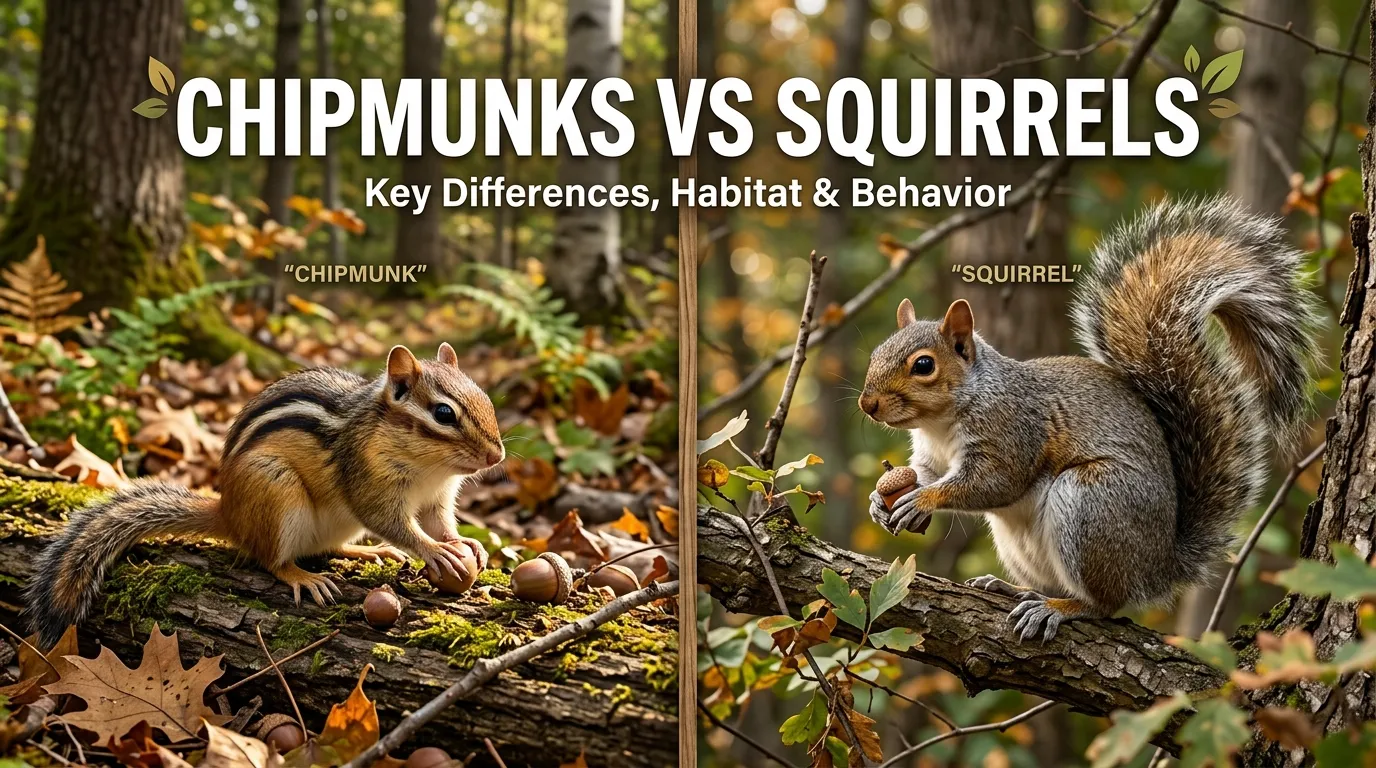
Chipmunks and squirrels are closely related rodents in the family Sciuridae, but they differ in size, markings, habitat, and behavior.
Chipmunks are usually smaller, have distinctive stripes, shorter tails, cheek pouches, and underground burrows. Common tree squirrels are larger, have bushy tails, spend more time in trees, and usually build nests above the ground.
Key Takeaways
- Chipmunks are technically a type of squirrel, but they are different from the tree squirrels commonly seen in yards.
- Chipmunks are smaller and usually have obvious stripes on their bodies and faces.
- Tree squirrels are larger, with long, bushy tails and a strong preference for trees.
- Chipmunks carry food in expandable cheek pouches and commonly store it in underground burrows.
- Winter behavior varies by species, but chipmunks commonly enter periods of torpor, while many tree squirrels remain active.
Are Chipmunks and Squirrels the Same Thing?
The answer is yes and no.
Chipmunks and squirrels belong to the same biological family, Sciuridae. In that broad sense, a chipmunk is a type of squirrel. However, when people say “squirrel,” they usually mean one of the familiar tree squirrels, such as gray, fox, or red squirrels.
This distinction explains why chipmunks can look both familiar and completely different from the squirrels climbing trees in a backyard.
Chipmunks are generally small, ground-focused animals. Common tree squirrels are larger and are much more closely associated with trees. Both are rodents and share many behaviors, including eating seeds and nuts and storing food for later.
Chipmunks vs Squirrels: Key Differences
| Feature | Chipmunks | Common Tree Squirrels |
| Size | Usually small | Generally larger |
| Body markings | Distinct stripes | Usually no body stripes |
| Face | Stripes often extend onto face | Usually lacks chipmunk-style facial stripes |
| Tail | Shorter and less bushy | Long and very bushy |
| Main habitat | Ground, woodland floor, burrows | Trees, woodland, parks, yards |
| Home | Underground burrow | Tree nest or cavity |
| Cheek pouches | Yes | Generally absent |
| Food storage | Often centralized underground | Often scattered throughout an area |
| Winter behavior | Often enters torpor | Many tree squirrels stay active |
The exact size and appearance vary by species, so these traits should be used together rather than relying on only one characteristic.
Size and Appearance
One of the easiest ways to distinguish them is size.
The eastern chipmunk, for example, is a small animal that typically measures about 5 to 6 inches in body length and weighs around 3 ounces, with a hairy tail adding several inches. Common tree squirrels are considerably larger and often have a much more noticeable body and tail.
If the animal looks tiny and compact while moving around a stone wall, garden bed, or forest floor, a chipmunk is a strong possibility.
If it has a larger body and a dramatic, fluffy tail, it is more likely to be a tree squirrel.
Stripes and Facial Markings
Stripes are probably the quickest visual clue.
Chipmunks typically have several dark and light stripes running along their backs. Many also have distinctive facial stripes. The National Park Service notes that facial stripes are an especially useful feature for identifying chipmunks.
Most familiar tree squirrels, such as gray squirrels, do not have this type of striped pattern.
There is an important exception: some ground squirrels are striped, which can make identification more difficult. For example, the 13-lined ground squirrel has body stripes but differs from a chipmunk in its pattern and facial markings.
Tails
The tail provides another useful clue.
Tree squirrels generally have long, full, bushy tails. Their tails help with balance while climbing and moving between branches.
Chipmunks have shorter, less bushy tails. When running, they may hold the tail upright, making their movement look very different from the bounding movement of a tree squirrel.
So, when identifying an animal quickly, look at the tail after checking its size and stripes.
Cheek Pouches
Chipmunks have expandable cheek pouches that act like built-in food bags.
They can collect seeds and other food, fill their cheek pouches, and carry the food back to their burrows. These pouches are particularly useful because chipmunks frequently make repeated trips between feeding areas and their underground storage areas.
This is one of the most interesting differences between chipmunks and the common tree squirrels people see in North American yards.
Habitat and Where They Live
Habitat is another strong clue.
Chipmunk Burrows
Chipmunks are primarily ground-dwelling. They commonly live in woodland environments and areas containing rocks, logs, shrubs, gardens, and other protective cover.
Their underground burrows can contain tunnels, sleeping areas, and food-storage chambers. The National Wildlife Federation describes chipmunk burrows as elaborate systems that may extend well below the surface.
Although chipmunks can climb, they generally spend much more time on the ground than tree squirrels.
Squirrel Nests and Trees
Common tree squirrels are more strongly associated with trees.
They may build nests in branches or use natural cavities and other elevated shelter. They also spend substantial amounts of time climbing, jumping, and moving through tree canopies.
You can therefore often identify the animal simply by watching where it spends most of its time: underground and on the ground suggests chipmunk; trees and branches suggest a tree squirrel.
Diet and Food Storage
Chipmunks and squirrels have overlapping diets, but their feeding strategies differ.
What Chipmunks Eat
Chipmunks eat a wide range of foods. Their diet can include nuts, seeds, fruits, buds, fungi, insects, worms, and other small food items.
They may also visit gardens and bird feeders when food is easy to access.
What Squirrels Eat
Tree squirrels commonly eat nuts and seeds, including acorns. Depending on the species and season, they may also consume fruits, buds, fungi, flowers, insects, or other available foods.
This is why both animals may appear around the same backyard even though they use the space differently.
How They Store Food
Their storage strategies are particularly interesting.
Many tree squirrels, including gray and fox squirrels, scatter-hoard food. They bury individual nuts and seeds in numerous locations and later return to recover them.
Chipmunks commonly use a different strategy. They carry food back to their underground burrows and store supplies in centralized chambers. Their cheek pouches make this process efficient.
In simple terms:
Squirrel: “Hide food in many places.”
Chipmunk: “Carry food home to the underground pantry.”
Do Chipmunks and Squirrels Hibernate?
Winter behavior is more complicated than a simple “yes” or “no.”
Chipmunks commonly spend winter underground and enter repeated periods of torpor, during which their body temperature and metabolic activity drop. They periodically wake and use stored food.
Many familiar tree squirrels, including gray and fox squirrels, do not undergo this type of prolonged winter torpor. Instead, they remain active and rely heavily on food caches.
However, the word squirrel covers many different species. Some ground squirrels have very different winter behavior and can undergo prolonged hibernation. So it is better to identify the species before making a general statement about all squirrels.
How to Tell a Chipmunk From a Squirrel
If you see a small animal in your yard and want to identify it quickly, use this checklist:
- Look at the size. A small, compact animal is more likely to be a chipmunk.
- Check for stripes. Strong stripes, especially facial stripes, point toward a chipmunk.
- Look at the tail. A long, fluffy tail usually suggests a tree squirrel.
- Watch where it moves. Ground-level movement and burrowing suggest a chipmunk; climbing and jumping through trees suggest a tree squirrel.
- Look for cheek pouches. Visible food-filled cheek pouches are a useful chipmunk clue.
- Check for a burrow. Chipmunks commonly use underground burrow systems.
Remember that ground squirrels can complicate identification because some are also small and striped. Facial markings, tail position, body shape, and behavior together provide a more reliable identification than any single feature.
Can Chipmunks and Squirrels Cause Problems Around Your Home?
Both animals can become backyard nuisances under certain circumstances.
Chipmunks may dig around patios, stairs, retaining walls, foundations, gardens, and other structures. They can also eat bulbs, seeds, and seedlings. Pennsylvania State University notes that burrowing can sometimes cause structural concerns when chipmunks establish tunnels near buildings.
Squirrels can also cause problems by digging in gardens, raiding bird feeders, chewing materials, or entering buildings.
That does not mean either animal is automatically harmful. Both play ecological roles, including seed movement and food-web interactions. Chipmunks, for example, can help disperse seeds and aerate soil through their digging.
If an animal is causing damage, identification is useful because the appropriate wildlife-management approach can depend on the species and local regulations.
FAQs:
Are chipmunks smaller than squirrels?
Usually, yes. Common chipmunks are much smaller than familiar tree squirrels. An eastern chipmunk is only a few ounces, while common tree squirrels can weigh considerably more. Exact size varies among species, so comparing a chipmunk with a particular squirrel species gives the most accurate result.
Do squirrels have cheek pouches?
Common tree squirrels do not have the prominent expandable cheek pouches that chipmunks use to carry food. Chipmunks can collect seeds and nuts in these pouches and transport them back to their underground burrows.
Do chipmunks climb trees?
Yes. Chipmunks are capable of climbing trees, but they are primarily ground-dwelling animals. They spend much of their time foraging on the ground and using underground burrows, unlike tree squirrels, which are strongly adapted to life in trees.
Are chipmunks and squirrels related?
Yes. Both belong to the squirrel family, Sciuridae. In fact, chipmunks are considered part of the broader squirrel group. The everyday distinction is mainly between chipmunks and the larger tree squirrels commonly seen in yards and parks.
Do chipmunks and squirrels eat the same food?
Their diets overlap considerably. Both may eat nuts, seeds, fruits, and other plant foods. Chipmunks also consume insects and other animal-based foods. Diet varies by species, season, and what food is available in the local environment.
Conclusion:
The easiest way to remember chipmunks vs squirrels is to focus on four clues: size, stripes, tail, and habitat.
Chipmunks are generally smaller, striped, short-tailed, ground-oriented animals that use burrows and cheek pouches to transport and store food. Common tree squirrels are larger, usually lack chipmunk-style stripes, have long bushy tails, and spend much more time in trees.
They are not completely unrelated animals, though. Both belong to the squirrel family, which is why their behavior and appearance sometimes overlap. When identification is difficult, combining several clues is more reliable than judging the animal by size alone.

I am Noah Bennett, the creative mind behind DreamFlirtz, where style meets modern digital vibes. ✨
I am here to turn ideas into trends and make dreamflirtz.com stand out. 🚀