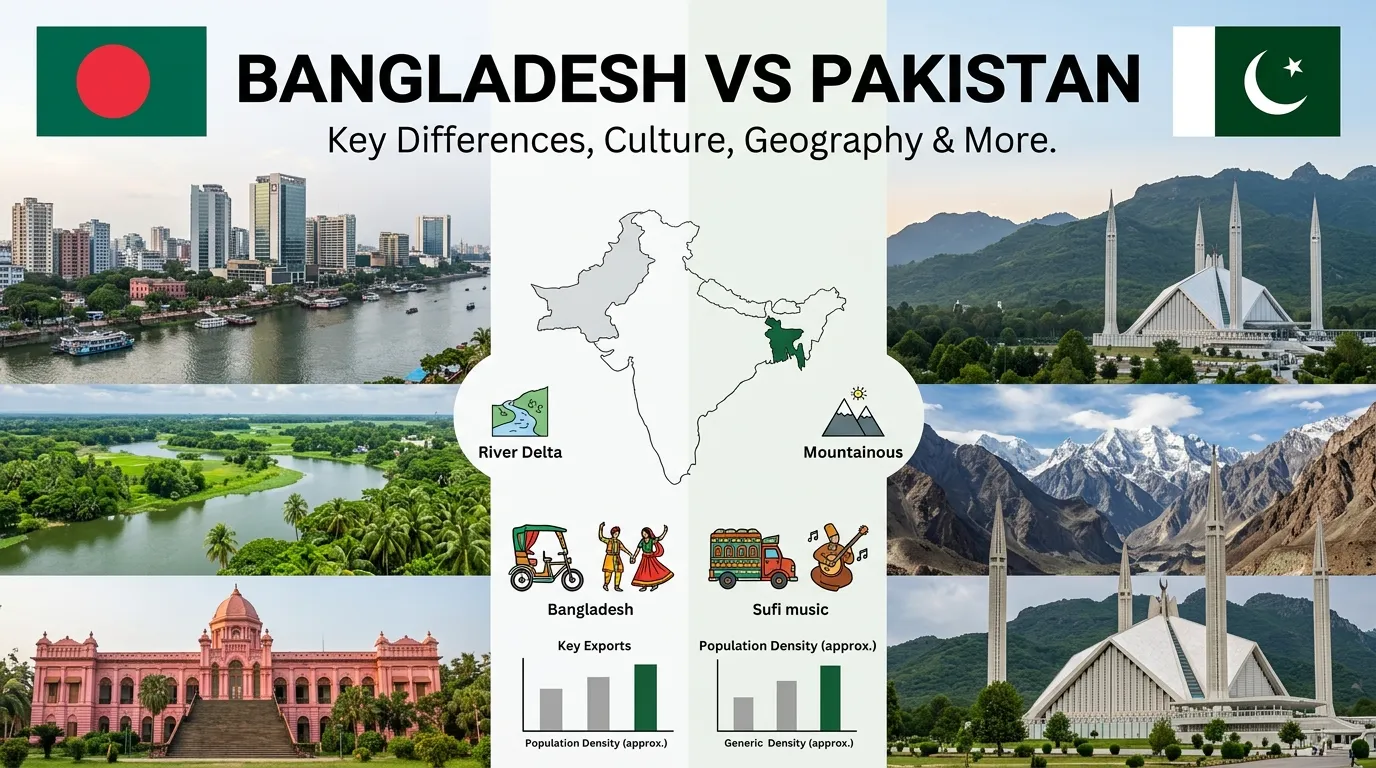
Bangladesh and Pakistan are two South Asian countries with a shared history but major differences in geography, population, economy, language, and culture.
Pakistan is much larger by land area and has more people, while Bangladesh currently has a larger nominal GDP and higher GDP per capita. The two countries also have a strong cricket rivalry.
Key Takeaways
- Pakistan has about 255.2 million people, compared with about 175.7 million in Bangladesh.
- Pakistan’s land area is roughly six times larger than Bangladesh’s.
- Bangladesh’s 2025 nominal GDP was about $456.3 billion, compared with $407.3 billion for Pakistan.
- Bangladesh and Pakistan were politically connected until Bangladesh became independent in 1971.
- In the 2026 bilateral cricket series, Bangladesh won both the ODI series and the Test series.
Bangladesh vs Pakistan: Quick Comparison
The comparison between Bangladesh and Pakistan can mean several things. Some people are interested in population and economic statistics, while others want to understand their history, culture, geography, or cricket rivalry.
Both countries are in South Asia and have large Muslim-majority populations. However, their physical geography is very different.
| Category | Bangladesh | Pakistan |
| Capital | Dhaka | Islamabad |
| Region | South Asia | South Asia |
| Population, 2025 | 175.7 million | 255.2 million |
| GDP, 2025 | $456.3 billion | $407.3 billion |
| GDP per capita, 2025 | $2,597 | $1,596 |
| Area | About 147,570 km² | About 881,913 km² |
| Main national language | Bengali/Bangla | Urdu |
| Coastline | Bay of Bengal | Arabian Sea |
| Independence | 1971 | 1947 |
The economic and population figures above use the latest comparable World Bank data available for 2025.
Population and Geography
Which Country Is Bigger?
Pakistan is considerably larger geographically. The World Bank gives Pakistan an area of about 881,913 square kilometers, while Bangladesh covers roughly 147,570 square kilometers.
That means Pakistan is close to six times larger by area.
The landscapes are also very different. Pakistan stretches across mountains, plateaus, deserts, plains, and coastal areas. Its geography includes the Himalaya, Karakoram, and Hindu Kush mountain systems.
Bangladesh is much smaller but extremely dense. Much of the country is formed by the enormous river systems associated with the Ganges, Brahmaputra, and Meghna. Its landscape includes river deltas, floodplains, wetlands, agricultural areas, and a long coastline along the Bay of Bengal.
Which Has More People?
Pakistan has the larger population.
World Bank figures put Pakistan’s 2025 population at about 255.2 million, compared with approximately 175.7 million in Bangladesh.
Despite having a much smaller land area, Bangladesh has a very high population density. Pakistan has more total people but considerably more land on which that population is distributed.
This distinction is important: population size and population density are not the same measurement.
Economy and Income
GDP Comparison
Bangladesh and Pakistan are both classified as lower-middle-income economies, but their economic structures have developed differently.
According to the World Bank’s 2025 data, Bangladesh’s nominal GDP was approximately $456.3 billion, while Pakistan’s was about $407.3 billion.
So, by total nominal GDP, Bangladesh’s economy was larger in 2025.
Bangladesh’s economic development has been strongly associated with manufacturing and exports, particularly ready-made garments and textiles. Agriculture, remittances, services, and manufacturing also play important roles.
Pakistan has a broad economy that includes agriculture, manufacturing, services, textiles, food processing, chemicals, and other industries. Remittances are also an important source of external income.
GDP Per Capita
GDP per capita gives a different perspective.
Bangladesh recorded about $2,597 per person in 2025, compared with approximately $1,596 per person for Pakistan.
GDP per capita is not the same as an individual’s actual salary or household income. It simply divides total economic output by population. Still, it helps explain why a country with a smaller population can have a higher GDP per person.
The World Bank also reports a life expectancy of about 75 years in Bangladesh and 68 years in Pakistan for 2024.
History and Relationship
Bangladesh and Pakistan have a closely connected modern history.
From British India to Pakistan
Before independence, the territories that are now Bangladesh and Pakistan were part of British India.
When British India was partitioned in 1947, Pakistan was created with two geographically separated regions: West Pakistan and East Pakistan.
East Pakistan was the eastern part of the new country and was separated from West Pakistan by roughly 1,800 kilometers of Indian territory.
The two regions had major linguistic, cultural, political, and economic differences.
Bangladesh’s Independence in 1971
Tensions between East and West Pakistan increased over political representation, language, economic issues, and regional autonomy.
After the 1970 general election and the political crisis that followed, conflict escalated in 1971. A nine-month war ultimately ended with the surrender of Pakistani forces in December 1971 and the emergence of Bangladesh as an independent country.
The historical relationship remains important when understanding modern Bangladesh-Pakistan relations. It also explains why comparisons between the two countries can carry a historical dimension beyond simple statistics.
Language and Culture
Language is one of the clearest differences.
Bangla, or Bengali, is the principal language of Bangladesh and is spoken by more than 99% of the country’s population, according to Bangladesh’s government information. English is also widely understood in urban and professional settings.
Urdu is Pakistan’s national language, while many other languages are widely spoken across the country, including Punjabi, Sindhi, Pashto, and Balochi.
Culture also varies significantly.
Bangladesh has a strong Bengali cultural identity expressed through literature, music, food, festivals, clothing, and the Bengali language. Pakistan has diverse regional cultures shaped by its different provinces and ethnic communities.
At the same time, both countries share parts of the broader cultural heritage of South Asia, including religious traditions, foods, family structures, cricket culture, and historical influences.
Bangladesh vs Pakistan in Cricket
Cricket is one of the most visible areas of comparison between Bangladesh and Pakistan.
The two national teams regularly meet in Tests, ODIs, and T20 cricket. Their matches attract large audiences across South Asia and among diaspora communities around the world.
The 2026 bilateral series provided a particularly notable recent comparison.
2026 ODI Series
Bangladesh hosted Pakistan for a three-match ODI series in March 2026.
Bangladesh won the first ODI by eight wickets. Pakistan won the second match by 128 runs under the DLS method. Bangladesh then won the third ODI by 11 runs.
As a result, Bangladesh won the ODI series 2–1.
2026 Test Series
The teams also played two Tests in May 2026.
Bangladesh won the first Test in Mirpur by 104 runs and the second Test in Sylhet by 78 runs.
Bangladesh therefore won the two-match Test series 2–0.
These results describe the 2026 bilateral series specifically; they should not be treated as a complete measure of either country’s historical cricket strength.
Military and National Scale
Pakistan and Bangladesh also differ substantially in military scale.
Pakistan has a much larger territory, population, defense establishment, and conventional military inventory. Current military comparison databases show substantial differences in personnel, aircraft, armored vehicles, and other equipment.
However, military comparisons depend heavily on methodology. Equipment counts alone do not measure training, readiness, logistics, doctrine, technology, alliances, or actual wartime performance.
For that reason, a military comparison is best understood as a comparison of documented capabilities rather than a prediction of what would happen in a hypothetical conflict.
Bangladesh vs Pakistan: Main Differences
The easiest way to understand the comparison is to separate the categories.
Geography: Pakistan is much larger.
Population: Pakistan has about 80 million more people based on 2025 World Bank figures.
Economy: Bangladesh had the larger nominal GDP in 2025.
GDP per capita: Bangladesh also recorded the higher GDP per capita.
Language: Bengali is the principal language of Bangladesh, while Urdu is Pakistan’s national language alongside numerous regional languages.
History: Bangladesh was formerly East Pakistan and became independent in 1971.
Cricket: Bangladesh won the 2026 ODI series 2–1 and the Test series 2–0.
There is therefore no single statistic that completely describes the difference between the two countries. The answer changes depending on whether the comparison is about land, population, economic output, income per person, history, or sport.
Frequently Asked Questions
Is Bangladesh bigger than Pakistan?
No. Pakistan is much larger by land area. Pakistan covers about 881,913 square kilometers, while Bangladesh covers roughly 147,570 square kilometers. Pakistan is therefore close to six times larger geographically.
Is Bangladesh richer than Pakistan?
It depends on the measurement. In 2025, Bangladesh had the larger nominal GDP and higher GDP per capita according to World Bank data. Bangladesh’s GDP was about $456.3 billion compared with Pakistan’s $407.3 billion, while GDP per capita was about $2,597 versus $1,596.
Why did Bangladesh separate from Pakistan?
Bangladesh became independent after years of political, linguistic, economic, and regional tensions between East and West Pakistan. The conflict escalated into the 1971 Liberation War, which ended with the creation of Bangladesh as an independent state.
Who won the 2026 Bangladesh vs Pakistan cricket series?
Bangladesh won both bilateral series played in 2026. Bangladesh won the three-match ODI series 2–1 and the two-match Test series 2–0.
Which country has more people?
Pakistan has more people. The World Bank’s 2025 figures list approximately 255.2 million people in Pakistan compared with 175.7 million in Bangladesh.
Conclusion:
Bangladesh and Pakistan are large South Asian countries with shared historical roots but very different geographic and demographic profiles.
Pakistan is much larger in area and population, while Bangladesh had the larger nominal economy and higher GDP per capita in the latest World Bank data. Their languages, landscapes, political histories, and cultural identities are also distinct.
For cricket fans, the 2026 results add another useful part to the comparison: Bangladesh won both the ODI and Test series against Pakistan that year.
The most accurate way to compare Bangladesh vs Pakistan is therefore to look at the specific category that matters—rather than treating one statistic as the answer to every comparison.

I am Jason Bennett, a confident guy who enjoys good vibes, fun conversations, and meeting interesting people.
I am here on DreamFlirtz.com to make exciting connections and turn simple chats into memorable moments.