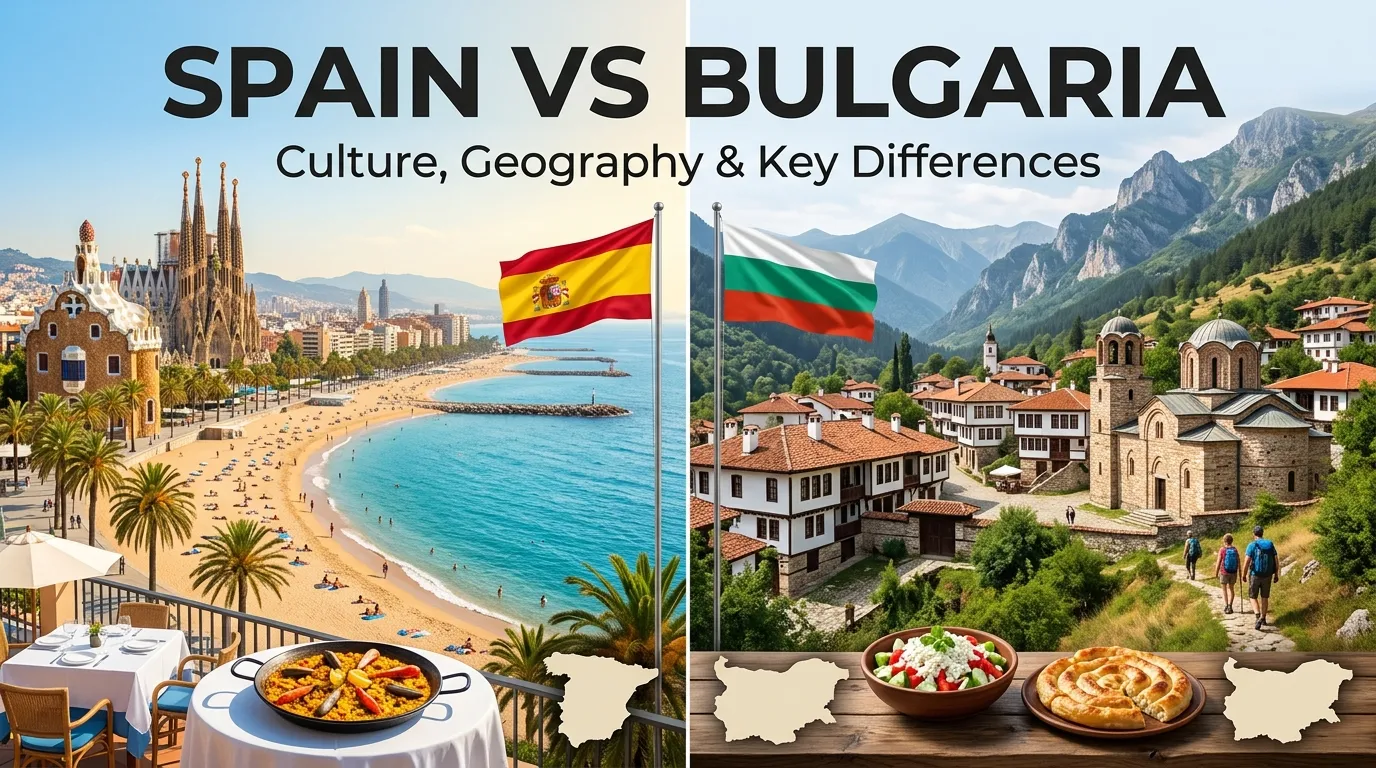
Spain and Bulgaria are both European Union countries that use the euro and belong to the Schengen Area, but they differ greatly in size, population, climate, culture, and living costs.
Spain is much larger and more populous, while Bulgaria is generally less expensive. Both offer beaches, historic cities, outdoor activities, and distinct cultural experiences.
Key Takeaways
- Spain is much larger and has a population of about 49 million, compared with roughly 6.4 million in Bulgaria.
- Both countries use the euro and are part of the EU and Schengen Area.
- Bulgaria generally has a lower cost of living than Spain, although the difference depends heavily on the city and lifestyle.
- Spain offers Mediterranean and Atlantic beaches, major cities, diverse regional cultures, and a large tourism industry.
- Bulgaria combines Black Sea resorts, mountains, historic towns, and generally lower everyday costs.
Spain vs Bulgaria: Quick Comparison
At first glance, Spain and Bulgaria may seem difficult to compare because they offer very different experiences. Spain is in southwestern Europe and covers a large area that includes mainland territory and islands. Bulgaria is in southeastern Europe, bordering Romania, Serbia, North Macedonia, Greece, Turkey, and the Black Sea.
Spain’s 2025 population was about 49.1 million, while Bulgaria’s was about 6.4 million. Spain covers approximately 506,000 square kilometers, compared with about 111,000 square kilometers for Bulgaria.
| Feature | Spain | Bulgaria |
| Capital | Madrid | Sofia |
| Official EU language | Spanish | Bulgarian |
| Population | About 49.1 million | About 6.4 million |
| Area | About 506,000 km² | About 111,000 km² |
| Currency | Euro (€) | Euro (€) |
| EU member | Yes | Yes |
| Schengen | Yes | Yes |
| Geography | Mediterranean, Atlantic, mountains, islands | Black Sea, mountains, plains |
| General travel cost | Higher | Generally lower |
Both countries are now euro-area members. Spain adopted the euro long ago, while Bulgaria officially adopted it on January 1, 2026.
Spain vs Bulgaria: Cost of Living
Cost is one of the biggest differences people notice when comparing Spain vs Bulgaria.
Recent cost-of-living comparison databases generally place Bulgaria below Spain in overall everyday expenses. However, there is no single price difference that applies everywhere. Madrid and Barcelona, for example, can be very different from smaller Spanish cities, just as Sofia differs from smaller Bulgarian towns.
Housing is particularly important. Rent and accommodation can represent a much larger portion of a travel or relocation budget in major Spanish cities. Bulgaria generally offers lower housing costs, although popular areas and tourist destinations can also become more expensive.
Food, transportation, restaurants, entertainment, and services can also cost less in Bulgaria. Still, travelers should compare specific cities rather than assuming that every item will be cheaper.
For someone planning a longer stay on a limited budget, Bulgaria may provide more spending flexibility. For someone earning a Spanish or U.S. income, the difference can also make Bulgaria attractive for certain travel or remote-work budgets.
Spain vs Bulgaria for Travel
Both countries can work well for a European vacation, but the experiences are quite different.
Spain’s Travel Experience
Spain is one of Europe’s most diverse travel destinations. Visitors can explore Madrid, Barcelona, Seville, Valencia, Granada, Bilbao, Mallorca, the Canary Islands, and many smaller destinations.
The country combines Mediterranean beaches, historic architecture, museums, nightlife, regional cuisines, mountains, islands, and large cultural events.
Spain is especially appealing to travelers who want variety within one country. A single trip can include major cities, coastal resorts, historic villages, and outdoor destinations.
Its large tourism industry also means visitors can find a wide range of accommodation, transportation, restaurants, and organized activities.
Bulgaria’s Travel Experience
Bulgaria offers a different style of European travel. Sofia provides urban attractions and access to nearby mountains, while cities such as Plovdiv and historic areas such as Veliko Tarnovo provide additional cultural experiences.
The Black Sea coast offers beach destinations, while inland Bulgaria is known for mountains, forests, ski areas, monasteries, and rural landscapes.
Bulgaria can also appeal to travelers looking for a European destination where their budget may stretch further than in many Western European tourist centers.
Climate and Geography
Spain has a wide range of climates because of its size and varied geography. Coastal Mediterranean areas often have hot, dry summers and relatively mild winters. Northern Spain is generally wetter, while inland areas can experience greater seasonal temperature differences.
The Canary Islands also provide a distinct climate compared with mainland Spain.
Bulgaria has a more continental climate in much of the country, with warmer summers and colder winters than many Mediterranean areas of Spain. Mountain regions are colder and receive significant snowfall, making Bulgaria an established destination for winter sports.
The Black Sea coast has its own coastal climate and attracts summer visitors.
So, climate choice depends heavily on the specific region rather than simply choosing one country over the other.
Culture, Food, and Language
Spain’s cultural identity varies strongly from region to region. Spanish is the main official language at the national level, while several autonomous communities also have co-official regional languages.
Spanish cuisine is internationally recognized for dishes and traditions such as paella, tapas, tortilla española, regional seafood, cured meats, and numerous local specialties.
Bulgaria has a distinct South Slavic cultural heritage. Bulgarian is the official language, and the Cyrillic alphabet is central to written Bulgarian.
Bulgarian cuisine includes dishes such as shopska salad, banitsa, grilled meats, yogurt-based foods, and a wide range of regional dishes.
Neither country’s food culture can be summarized by only a few famous dishes. Regional traditions play a major role in both.
Economy and Lifestyle
Spain has a substantially larger economy and population than Bulgaria. World Bank data for 2025 put Spain’s GDP at about $1.91 trillion and Bulgaria’s at about $131 billion. Spain also had a much higher GDP per capita in current U.S. dollars.
These figures describe the scale of the national economies, but they do not automatically determine an individual’s quality of life.
Bulgaria has undergone major economic changes since joining the European Union in 2007. It became a high-income economy according to the World Bank’s classification and has continued integrating with European economic institutions.
Spain has a larger and more diversified economy, with important sectors including services, tourism, manufacturing, agriculture, transportation, and technology.
For residents, actual living conditions depend on factors such as salary, housing costs, location, employment, healthcare, transportation, and personal spending habits.
Which Is Better for Different Types of Travelers?
Rather than asking which country is universally better, it makes more sense to match the destination to the type of trip you want.
For Beaches and Mediterranean Travel
Spain provides access to extensive Mediterranean and Atlantic coastlines as well as islands such as Mallorca, Ibiza, Tenerife, and Gran Canaria.
Bulgaria’s Black Sea coast offers another type of European beach experience, with resorts and coastal towns that can be particularly attractive during summer.
For Budget Travel
Bulgaria is generally associated with lower everyday travel and living costs. Recent comparison databases also show lower average costs in Bulgaria, although the exact difference varies by city, accommodation, season, and spending habits.
Travelers should compare actual hotel and flight prices for their dates before creating a budget.
For Mountains and Nature
Both countries offer strong outdoor opportunities.
Spain has the Pyrenees, Sierra Nevada, Picos de Europa, Canary Island landscapes, and numerous national parks.
Bulgaria has the Rila, Pirin, and Balkan mountain ranges, along with forests, lakes, caves, and hiking areas.
The best choice depends on the specific outdoor activities you want.
For City and Cultural Trips
Spain has a larger selection of major international cities and famous cultural attractions. Bulgaria offers a more compact collection of historic cities and archaeological, religious, and architectural sites.
Travelers interested in ancient history can find something valuable in both countries.
Spain vs Bulgaria: Football Meaning
There is another important interpretation of the keyword Spain vs Bulgaria: football.
The two national teams met in 2025 during UEFA World Cup qualifying. Spain won the September 2025 meeting 3–0 and the October 2025 match 4–0.
Therefore, if someone searches “Spain vs Bulgaria” during a football tournament or qualification campaign, they may be looking for match results, statistics, lineups, or head-to-head records rather than a country comparison.
For the broader country-comparison meaning, however, the differences in cost, geography, culture, and travel experience are more relevant.
Frequently Asked Questions
Is Spain cheaper than Bulgaria?
Generally, Bulgaria has a lower cost of living than Spain. Housing, restaurants, transportation, and everyday services are often less expensive. However, costs vary significantly between cities. Sofia and major tourist destinations can be more expensive than smaller Bulgarian locations, while smaller Spanish cities can be considerably cheaper than Madrid or Barcelona.
Is Bulgaria in the eurozone?
Yes. Bulgaria adopted the euro on January 1, 2026, becoming the 21st member of the euro area. The official conversion rate was fixed at €1 = 1.95583 Bulgarian lev during the currency changeover.
Is Spain bigger than Bulgaria?
Yes. Spain is substantially larger. Spain covers about 506,000 square kilometers, while Bulgaria covers approximately 111,000 square kilometers. Spain also has a much larger population, with about 49 million people compared with roughly 6.4 million in Bulgaria.
Are Spain and Bulgaria both in Schengen?
Yes. Spain has been part of the Schengen Area since 1995. Bulgaria joined the Schengen Area in stages, with full Schengen membership following the removal of internal land-border checks in January 2025.
Conclusion:
Spain vs Bulgaria is not simply a comparison between two European countries. It is a choice between two different geographic regions, cultural traditions, travel styles, and cost structures.
Spain is larger, more populous, and offers an extensive range of cities, beaches, islands, food traditions, and cultural attractions. Bulgaria is smaller and generally less expensive, while offering Black Sea beaches, mountains, historic towns, and a different Eastern European cultural experience.
Both countries are EU and Schengen members, and as of 2026, both use the euro. For travelers, the better fit depends on budget, preferred climate, activities, destinations, and the type of European experience they want.