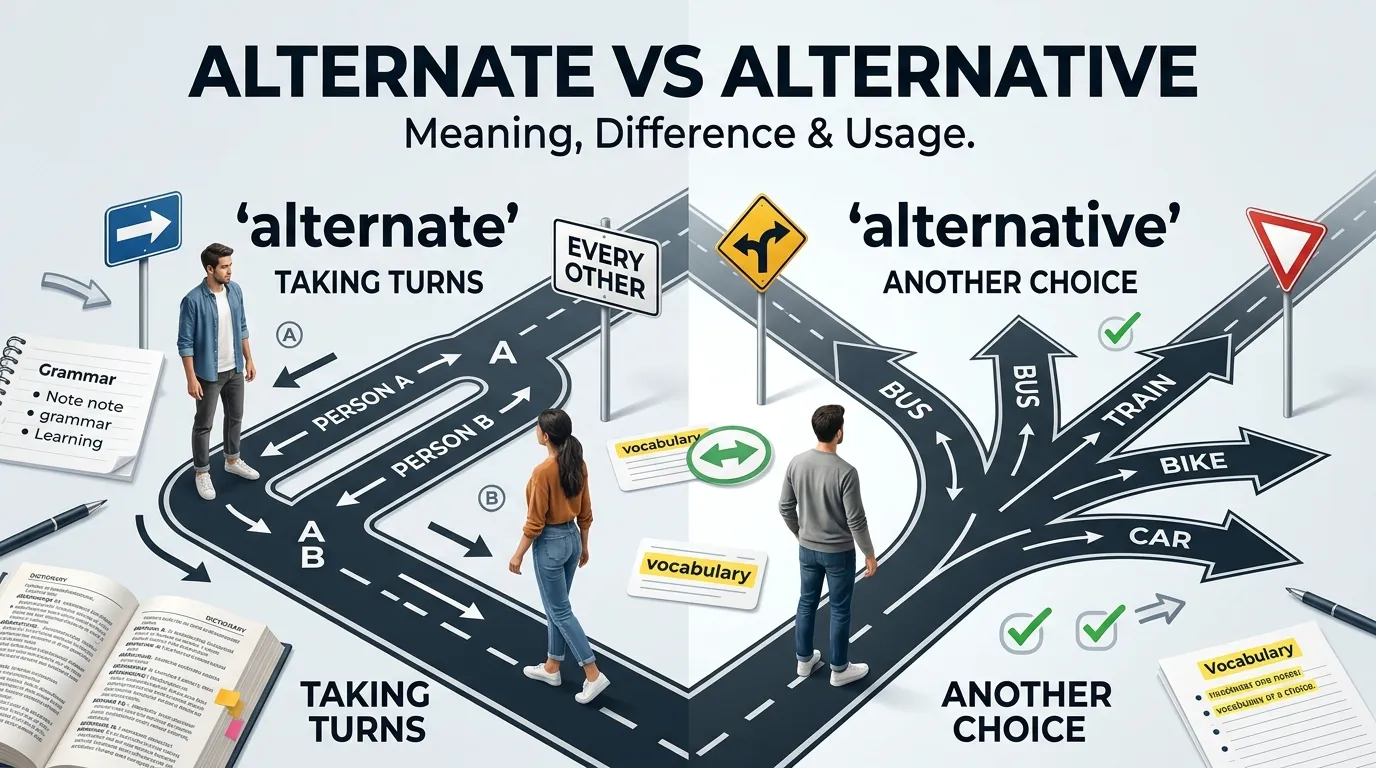
Alternate and alternative can both describe a different option in American English, but they have other distinct meanings.
Alternate can mean “every other,” “taking turns,” or a substitute, while alternative usually means another choice, option, or method.
Use the context to determine which word communicates your meaning most clearly.
Key Takeaways
- Alternate can mean taking turns, every other, or a substitute.
- Alternative usually means another choice, option, or possibility.
- In American English, alternate can sometimes be used where alternative would traditionally appear.
- Say alternate days when you mean every other day.
- Alternately describes things happening in turns, while alternatively introduces another possibility.
Alternate vs Alternative: The Main Difference
The words alternate and alternative are closely related, so it is easy to confuse them. In some American English contexts, they can even be used interchangeably.
The traditional distinction is useful, though.
Alternate often suggests a repeating pattern or something that takes another person’s or thing’s place. For example, if two activities happen one after another repeatedly, they alternate. If something happens on Monday, Wednesday, Friday, and so on, those are alternate days.
Alternative, on the other hand, usually refers to another choice or possibility. If your first plan does not work, you might consider an alternative plan.
American English has also expanded the use of alternate. It can mean a substitute or another available option, as in “an alternate route.” Major dictionaries recognize this U.S. usage.
What Does Alternate Mean?
Alternate has several meanings depending on how it is used.
Alternate as a Verb
As a verb, alternate means to switch between two things or to cause two things to happen in turns.
For example:
- We alternate between working from home and working in the office.
- The weather alternated between rain and sunshine.
- She alternates between coffee and tea.
The important idea is repeated change from one thing to another.
If two activities keep switching places, “alternate” is usually the natural verb.
Alternate as an Adjective
As an adjective, alternate traditionally means happening every other time or occurring in turns.
For example:
- We have meetings on alternate Mondays.
- The players wore alternate uniforms.
- The design uses alternate layers of black and white.
In the first sentence, alternate Mondays means every other Monday.
However, American English also uses alternate to mean a substitute or different option:
- Take the alternate route if the highway is closed.
- We created an alternate plan in case the first plan failed.
- The airline offered an alternate flight.
This use is widely recognized in American English.
Alternate as a Noun
In American English, alternate can also be a noun meaning a person or thing that can take the place of another.
For example:
- Sarah was selected as an alternate for the competition.
- The team named two alternates in case a player could not participate.
- He served as an alternate delegate.
Here, the word refers to a substitute or replacement.
What Does Alternative Mean?
Alternative generally refers to another choice, possibility, or method.
It can be used as both a noun and an adjective.
Alternative as a Noun
As a noun, an alternative is another option that someone can choose.
Examples include:
- We need an alternative to this software.
- Taking the train is a good alternative to driving.
- What is our alternative if the plan fails?
- She offered three alternatives.
The noun is especially useful when you are discussing choices or options.
A helpful pattern is:
an alternative to + noun
For example:
- an alternative to sugar
- an alternative to driving
- an alternative to traditional education
- an alternative to the original plan
Alternative as an Adjective
As an adjective, alternative describes something that provides another choice or differs from the usual approach.
Examples:
- We need an alternative solution.
- They developed an alternative method.
- The company is looking for alternative materials.
- We made alternative arrangements.
The word can also describe something outside the mainstream or traditional approach, as in alternative music, alternative education, or alternative medicine.
Alternate vs Alternative: Side-by-Side Comparison
| Word | Common meaning | Example |
| Alternate | Every other; taking turns | We meet on alternate Fridays. |
| Alternate | Substitute or replacement | She is an alternate delegate. |
| Alternate | Another option in U.S. usage | We took an alternate route. |
| Alternative | Another choice or possibility | We need an alternative solution. |
| Alternative | Different from the usual | They use alternative methods. |
The biggest distinction to remember is simple:
Alternate can describe a pattern of switching. Alternative usually describes another choice.
Alternate Route vs Alternative Route
Both alternate route and alternative route are used in American English.
If a highway is closed, you might see a sign telling drivers to take an alternate route. Here, alternate means another route that can be used instead.
You can also say:
We need an alternative route because the main road is closed.
That sentence is also natural.
So, in American English, the two expressions can overlap when alternate means “another available route.”
However, alternative has broader use when you are emphasizing a choice or possibility.
Alternate Plan vs Alternative Plan
Both expressions can also be correct.
For example:
We created an alternate plan in case the first plan failed.
And:
We created an alternative plan in case the first plan failed.
Both communicate the basic idea of another plan.
If you want to emphasize the idea of a substitute plan, “alternate plan” is common in American English.
If you are emphasizing another possible choice, “alternative plan” is a natural choice.
In everyday American writing, readers will generally understand either expression from context.
Alternate Days vs Alternative Days
This is one area where the distinction is especially important.
Use alternate days when you mean every other day.
For example:
I exercise on alternate days.
This means you exercise one day, skip the next, exercise the following day, and continue that pattern.
Do not replace this meaning with alternative days.
The same pattern appears with:
- alternate weeks
- alternate Mondays
- alternate weekends
- alternate years
For example:
The clinic is open on alternate Saturdays.
This means it is open every other Saturday.
This meaning is different from alternative, which refers to another option or possibility.
Alternately vs Alternatively
Another common confusion involves the adverbs alternately and alternatively.
Alternately means in turns or one after another.
Example:
The two speakers talked alternately.
This means the speakers took turns.
Alternatively means “as another possibility” or “instead.”
Example:
We could drive. Alternatively, we could take the train.
Here, the second option is being introduced.
A simple memory trick is:
Alternately = taking turns.
Alternatively = another option.
This distinction is especially useful in formal writing because confusing the two can change the meaning of a sentence.
Common Mistakes to Avoid
Mistake 1: Using “alternative” for every-other timing
Incorrect for the intended meaning:
We meet on alternative Fridays.
Better:
We meet on alternate Fridays.
When you mean every other, use alternate.
Mistake 2: Assuming “alternate” is always wrong
Some traditional grammar explanations reserve alternative for another choice. But American English commonly uses alternate for a substitute or another available option.
For example:
Take an alternate route.
This is normal American usage.
Mistake 3: Confusing “alternately” and “alternatively”
These words are not simply different spellings.
The colors appear alternately.
This describes a repeating pattern.
Alternatively, you can choose the blue version.
This introduces another possibility.
Mistake 4: Thinking there is always a strict either/or rule
English usage changes over time and differs by region. In American English, alternate has developed uses that overlap with alternative. Therefore, some sentences can naturally use either word.
The safest approach is to focus on the meaning you want to communicate rather than memorizing an absolute rule.
Which Word Should You Use?
Use alternate when you mean:
- every other
- taking turns
- switching between two things
- a substitute or stand-in
- another route, plan, or arrangement in common American usage
Use alternative when you mean:
- another choice
- another possibility
- another method
- an option instead of something else
- something different from the usual or traditional approach
When both are possible, choose the word that makes your intended meaning clearest.
For example:
Every other week:
We meet on alternate weeks.
Another possible method:
We need an alternative method.
A substitute person:
She is the team’s alternate.
Another option:
We need an alternative.
This approach keeps the traditional distinction clear while recognizing normal American English usage.
Frequently Asked Questions
Is alternate or alternative correct?
Both are correct words, but they are not identical in every context. Alternate can mean every other, taking turns, or a substitute. Alternative generally means another choice, possibility, or method. In American English, alternate can also mean another available option in contexts such as “alternate route.”
Can alternate and alternative be used interchangeably?
Sometimes. In American English, alternate and alternative can overlap when they describe another plan, route, method, or arrangement. They cannot always be exchanged, though. For example, alternate days means every other day, while alternative usually means another choice.
Is alternate mainly American English?
The use of alternate to mean another option or substitute is especially established in American English. Cambridge specifically identifies this meaning as U.S. usage. Traditional meanings of alternate, such as “every other” and “taking turns,” are much broader.
Should I say alternate days or alternative days?
Say alternate days when you mean every other day. For example, “I visit the gym on alternate days” means you go one day and skip the next. Alternative does not normally express this repeating time pattern.
What is the difference between alternately and alternatively?
Alternately means one after another or in turns. Alternatively means as another possibility or instead. For example, “The teams played alternately” describes taking turns, while “Alternatively, we could stay home” introduces another option.
Conclusion:
The difference between alternate vs alternative becomes easier once you focus on meaning.
Alternate can describe something that happens every other time, switches between things, or serves as a substitute. In American English, it can also mean another available option, such as an alternate route or alternate plan.
Alternative generally refers to another choice, possibility, method, or approach.
So remember the simplest distinction:
Alternate = every other, taking turns, or a substitute.
Alternative = another choice or possibility.
When American English allows both words, context usually makes the intended meaning clear.

I am Noah Bennett, the creative mind behind DreamFlirtz, where style meets modern digital vibes. ✨
I am here to turn ideas into trends and make dreamflirtz.com stand out. 🚀