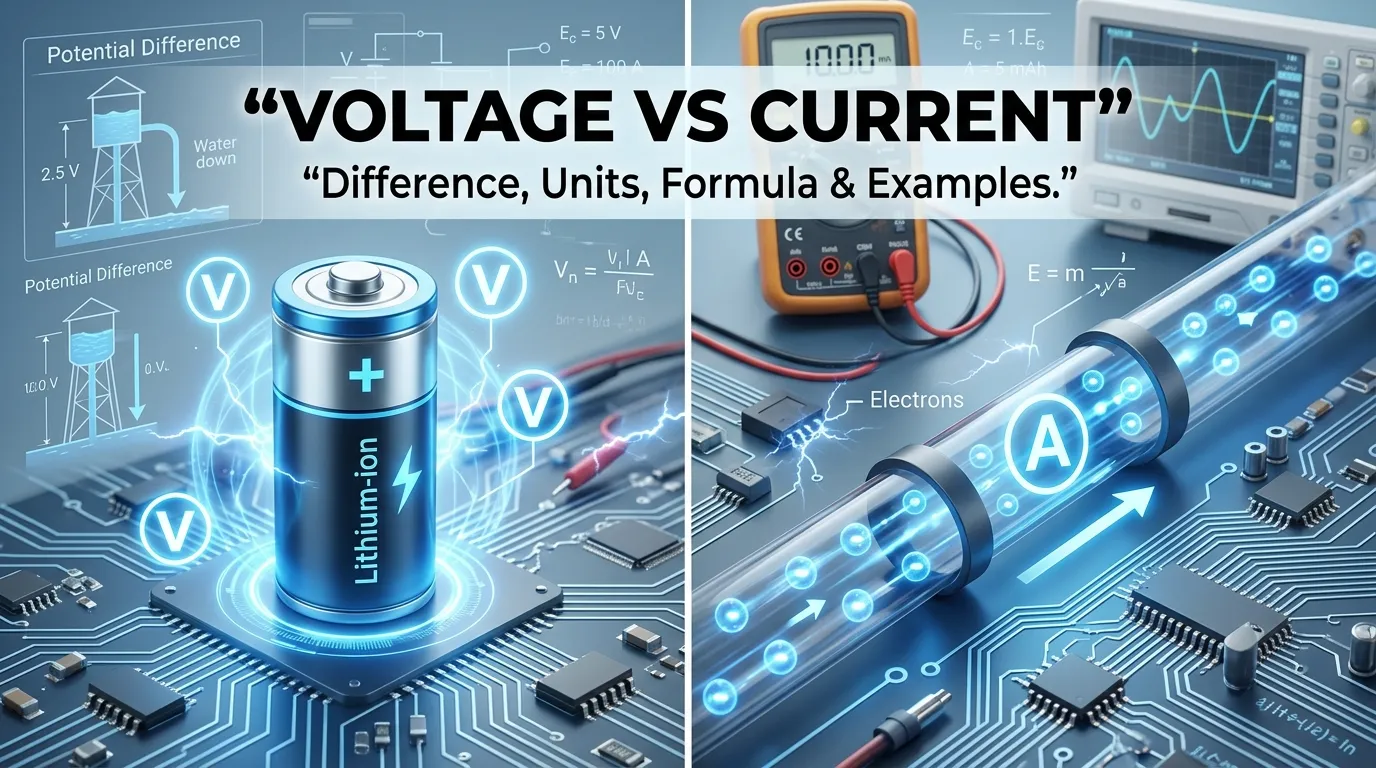
Voltage vs current: Voltage is the electrical potential difference between two points, measured in volts (V), while current is the rate at which electric charge moves through a circuit, measured in amperes or amps (A).
Voltage provides the potential difference that drives current, while current describes the amount of charge moving. Their relationship depends on resistance and is commonly expressed by Ohm’s law: V = I × R.
Key Takeaways
- Voltage is measured in volts and represents electrical potential difference.
- Current is measured in amps and represents the rate of charge flow.
- Voltage is measured across two points, while current is measured through a circuit element.
- For an ohmic component, Ohm’s law connects them: V = I × R.
- Electrical power is different from both voltage and current: P = V × I.
What Is Voltage?
Voltage is the difference in electric potential between two points. It tells you how much energy is associated with each unit of electric charge moving between those points.
Voltage is measured in volts (V). One volt equals one joule per coulomb, so voltage can also be understood as energy per unit of charge. The U.S. Department of Energy’s energy education material describes current as charge per unit time and voltage as energy per unit charge.
A simple way to picture voltage is to think about pressure in a water system. A pressure difference can push water through a pipe. Similarly, an electrical potential difference can drive charge through a circuit.
For example, a 9-volt battery establishes a potential difference of about 9 volts between its terminals under appropriate conditions. If you connect a suitable circuit between those terminals, that potential difference can produce current.
The important point is that voltage is not the amount of electricity flowing. Voltage is a potential difference; current is the flow rate.
What Is Current?
Electric current is the rate at which electric charge passes a particular point in a circuit.
Current is measured in amperes (A), commonly called amps. One ampere equals one coulomb of charge passing a point each second:
I = Q / t
where:
- I = current in amperes
- Q = electric charge in coulombs
- t = time in seconds
OpenStax defines electric current as the rate at which electric charge moves and gives one ampere as one coulomb per second.
In ordinary metal wires, electrons are the mobile charges. However, circuit diagrams normally use conventional current, whose direction is defined as the direction positive charge would move. As a result, conventional current and electron movement have opposite directions in a metal conductor.
Voltage vs Current: Key Differences
The easiest way to understand voltage vs current is to remember that voltage is an across quantity, while current is a through quantity.
| Feature | Voltage | Current |
| What it describes | Electric potential difference | Rate of charge flow |
| Symbol | V | I |
| Unit | Volt (V) | Ampere (A) |
| Basic idea | Energy per unit charge | Charge per unit time |
| Measured | Across two points | Through a circuit element |
| Typical meter | Voltmeter | Ammeter |
| Common equation | V = IR | I = V/R |
This distinction also explains why the two instruments are connected differently. A voltmeter measures the difference between two points, so it is connected across a component. An ammeter measures current through a circuit path, so it is placed in series with the path being measured.
Across vs. Through
Suppose you have a resistor in a circuit.
You measure the voltage across the resistor by comparing the electrical potential at its two terminals.
You measure the current through the resistor by determining how much charge passes through the circuit path.
Saying “voltage flows through the resistor” is therefore misleading. Voltage does not describe a flow rate. Current does.
How Voltage and Current Are Related
Voltage and current are closely connected, but they are not the same quantity.
For an ohmic component, their relationship is described by Ohm’s law:
V = I × R
You can rearrange it to find current:
I = V / R
or resistance:
R = V / I
Here:
- V = voltage in volts
- I = current in amps
- R = resistance in ohms
For an ohmic component under conditions where its resistance remains effectively constant, increasing voltage produces a proportional increase in current. OpenStax notes that Ohm’s law is an experimentally observed relationship and that not all materials and components behave ohmically.
Simple Example
Imagine a 12 V source connected to a 6 Ω resistor.
Using Ohm’s law:
I = V / R
I = 12 / 6 = 2 A
So the circuit has a current of 2 amps through that resistor.
If the resistance stayed at 6 Ω and the voltage increased to 24 V, the current would become:
I = 24 / 6 = 4 A
The example shows why voltage and current should not be treated as interchangeable. They are related mathematically, but they measure different things.
Voltage, Current, Resistance, and Power
Voltage and current are only two parts of the basic electrical picture.
Resistance describes how strongly a material or component opposes current. Its unit is the ohm (Ω).
Power describes the rate at which electrical energy is transferred or used. Its basic equation is:
P = V × I
Power is measured in watts (W). OpenStax and the Physics Classroom both give voltage multiplied by current as the electrical power relationship.
For example, if a device operates at 12 V and draws 2 A:
P = 12 × 2 = 24 W
So the device is associated with 24 watts of electrical power under those conditions.
This gives you a useful memory guide:
- Volts = potential difference
- Amps = current
- Ohms = resistance
- Watts = power
Voltage vs Current in Series and Parallel Circuits
Circuit arrangement changes how voltage and current behave.
Series Circuits
In a simple series circuit, the same current flows through each component because there is only one continuous path for charge.
The total voltage is divided among components according to their characteristics and resistance.
For example, if two resistors are connected in series, the current through both is the same, while the voltage drops across them can be different.
Parallel Circuits
In a parallel circuit, components are connected across the same two nodes. Therefore, each branch has the same voltage across it, while the total current divides between the branches.
This gives you a useful rule:
Series → current is shared.
Parallel → voltage is shared.
The exact current in each branch depends on its resistance.
How Voltage and Current Are Measured
Voltage and current require different measurement approaches.
Measuring Voltage
A voltmeter measures potential difference between two points. In a typical circuit, the meter is connected in parallel with the component being tested.
For example, to check the voltage across a resistor, the meter probes are placed at the resistor’s two terminals.
Measuring Current
An ammeter measures current through a circuit path. In traditional measurement setups, it is connected in series so that the circuit current passes through the meter.
Some modern current clamps can measure current without opening the circuit by sensing the magnetic field around a conductor. Fluke notes that current clamps are used for higher-current measurements and can avoid opening the circuit.
Because electrical measurements can involve hazardous energy, use equipment according to its ratings and follow appropriate electrical safety procedures.
Can You Have Voltage Without Current?
Yes.
This is one of the most important differences between voltage and current.
A circuit can have a potential difference even when there is no continuous current flowing through the load.
For example, a battery sitting on a table can have a measurable voltage between its terminals. If the circuit is open, however, there is no complete conducting path for continuous current to flow.
Once an appropriate circuit is completed, the voltage can drive current through the load.
This is why saying that voltage and current are simply two names for “electricity” creates confusion. They describe different properties of an electrical system.
Common Misunderstandings About Voltage and Current
“Voltage is the amount of electricity.”
Not quite. Voltage describes electric potential difference. Current describes charge flow.
“Amps and volts are interchangeable.”
They are not. An ampere measures current, while a volt measures potential difference.
“Higher voltage always means higher current.”
Not necessarily. Current also depends on resistance and the behavior of the circuit. For an ohmic resistor, Ohm’s law gives I = V/R.
“Current gets used up by a light bulb.”
In a simple series circuit, charge is not consumed by the bulb. Instead, electrical energy is transferred to other forms such as light and heat.
“Voltage and power are the same.”
They are different. Voltage is measured in volts, while power is measured in watts. Power depends on both voltage and current.
FAQs:
Are volts and amps the same?
No. Volts measure voltage, or electrical potential difference, while amps measure current, or the rate of electric charge flow. They are related through resistance in Ohm’s law, but they represent different physical quantities.
Is voltage more important than current?
Neither is universally “more important.” Their importance depends on what you are analyzing. Voltage tells you about potential difference, while current tells you about charge flow. In practical circuit analysis, both can be necessary, along with resistance and power.
Can high voltage exist with low current?
Yes. Voltage and current are separate quantities. A source can have a high potential difference while a particular circuit condition allows very little current. The resulting current depends on the complete electrical path and its resistance or other component characteristics.
What happens when resistance increases?
For a fixed voltage across an ohmic resistor, increasing resistance reduces current according to I = V/R. For example, with 12 V across a 6 Ω resistor, current is 2 A. With the same 12 V across a 12 Ω resistor, current becomes 1 A.
What is the difference between voltage and power?
Voltage measures electrical potential difference and is measured in volts. Power measures the rate of electrical energy transfer and is measured in watts. In a simple circuit, electrical power can be calculated with P = V × I.
Conclusion:
Understanding voltage vs current becomes much easier when you separate their basic roles. Voltage is the potential difference between two points, while current is the rate at which electric charge moves. Voltage is measured in volts, current in amps, and resistance connects them through Ohm’s law for ohmic components.
The simplest memory trick is: voltage is measured across, current is measured through. Once that distinction is clear, concepts such as resistance, power, series circuits, parallel circuits, and electrical measurements become much easier to understand.

I am Nathan Cole, exploring connections on DreamFlirtz.com I am confident, friendly, and always ready for a great chat.
I am someone who enjoys meeting amazing people and sharing good vibes. 🔥