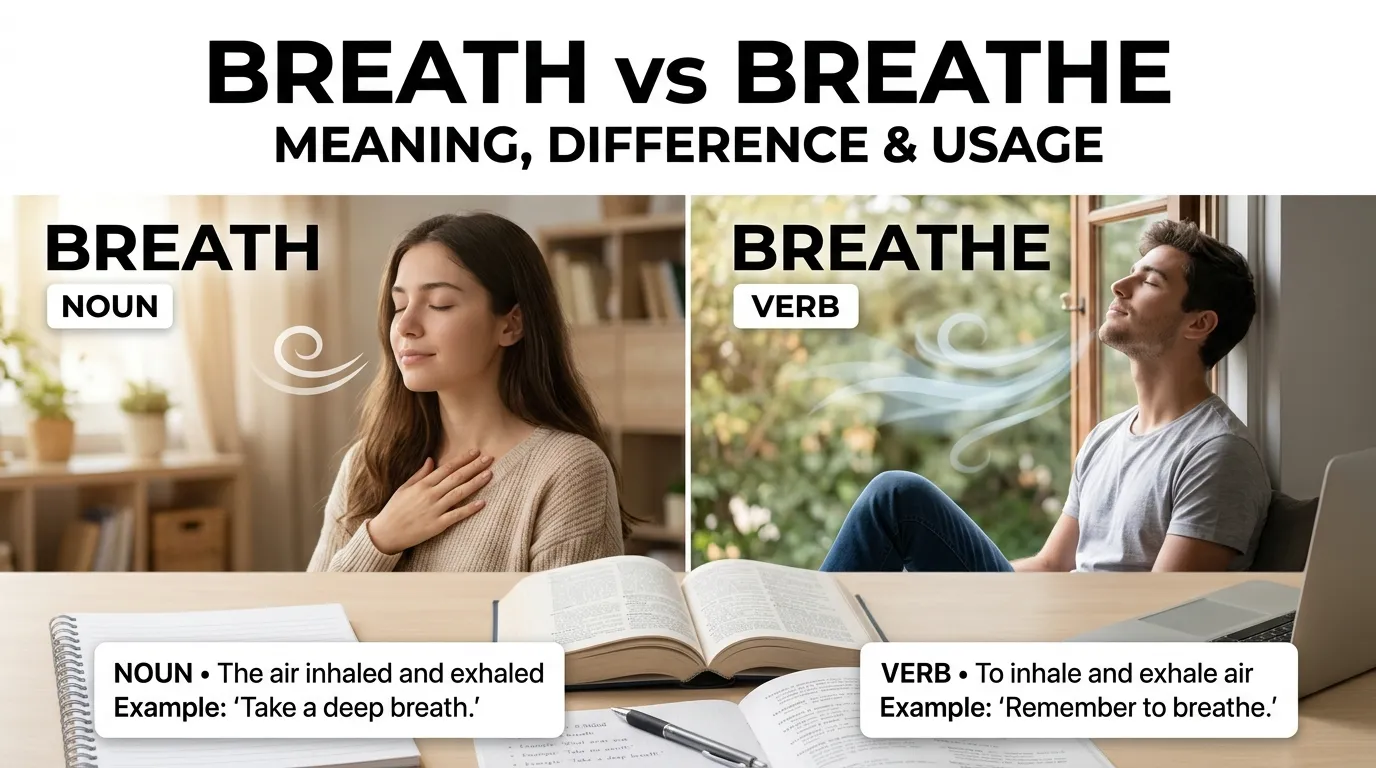
Breath is a noun meaning the air you take in or release from your lungs, or one act of breathing. Breathe is a verb meaning to move air into and out of your lungs.
The easiest rule is: you take a breath, but you breathe. They also have different pronunciations.
Key Takeaways
- Breath is a noun: “Take a deep breath.”
- Breathe is a verb: “Try to breathe slowly.”
- Breath sounds like “breth,” while breathe sounds like “breeth.”
- The final e in breathe helps distinguish its spelling and pronunciation.
- Remember: You take a breath, but you breathe.
Breath vs Breathe: The Main Difference
Breath and breathe are two of the most commonly confused English words. They are related because both deal with air moving in and out of the lungs, but they have different grammatical jobs.
The easiest way to understand the difference is to ask whether you are naming something or describing an action.
Breath = a noun.
Breathe = a verb.
For example:
Take a deep breath.
Here, breath names something you take.
Try to breathe slowly.
Here, breathe describes an action.
Cambridge defines breath as a noun referring to the air that goes into and out of the lungs, while breathe is a verb meaning to move air into and out of the lungs.
Breath Is a Noun
Breath is the noun form. It can refer to the air entering or leaving your lungs, one act of breathing, or your ability to breathe.
Examples:
- I took a deep breath.
- She held her breath.
- He was out of breath after running.
- I could see my breath in the cold air.
- Take a breath before you continue.
Because breath is a noun, you can often put words such as a, the, your, or deep before it.
Breathe Is a Verb
Breathe is the verb form. It describes the action of taking air into your lungs and letting it out.
Examples:
- Try to breathe slowly.
- I can hardly breathe in this stuffy room.
- Breathe in through your nose.
- Breathe out slowly.
- The baby was breathing peacefully.
The basic verb meaning is confirmed by Cambridge’s American English dictionary entry for breathe.
Breath vs Breathe Comparison Table
| Feature | Breath | Breathe |
| Part of speech | Noun | Verb |
| Basic meaning | Air or one act of breathing | The action of taking air in and out |
| Pronunciation | /breθ/ | /briːð/ |
| Simple sound | “breth” | “breeth” |
| Example | Take a deep breath. | Breathe deeply. |
| Common phrase | Hold your breath. | Breathe slowly. |
| Spelling | No final e | Ends in e |
The difference is more than one extra letter. The words also have different grammatical roles and sounds.
What Does “Breath” Mean?
Breath refers to the air that goes into or comes out of your lungs. It can also refer to a single act of breathing.
For example:
She took a deep breath before giving her speech.
In this sentence, breath is the name of one intake of air.
You will often see breath in common expressions such as:
- take a breath
- take a deep breath
- hold your breath
- catch your breath
- out of breath
- short of breath
- under your breath
- a breath of fresh air
For example:
After climbing the stairs, I stopped to catch my breath.
He was completely out of breath after the race.
These are standard noun uses of breath. Cambridge also lists expressions such as “catch your breath,” “hold your breath,” and “out of breath.”
Common Examples of Breath
Here are a few more examples:
- Take one more breath and relax.
- His breath smelled like coffee.
- She was trying to catch her breath.
- I could see her breath on the cold morning.
- He spoke under his breath.
What Does “Breathe” Mean?
Breathe is a verb that means to take air into your lungs and release it.
For example:
It is difficult to breathe in this crowded room.
You can also use breathe with in and out:
Breathe in slowly.
Breathe out through your mouth.
These combinations are especially common in instructions involving breathing. Cambridge specifically defines breathe in as moving air into the lungs and breathe out as moving air out of the lungs.
Common Examples of Breathe
- I need to breathe more slowly.
- Remember to breathe.
- She breathed deeply before speaking.
- The athlete was breathing heavily.
- Breathe in and then breathe out.
Notice how breathe describes something someone does.
Breath vs Breathe Pronunciation
Pronunciation is another important difference.
Breath is pronounced approximately “breth” and has the pronunciation /breθ/. The vowel is short, similar to the vowel sound in words such as bed or head.
Breathe is pronounced approximately “breeth” and has the pronunciation /briːð/. It has a long “ee” sound, like the vowel sound in see or need.
There is also a difference in the final th sound:
- breath → /θ/
- breathe → /ð/
So you can remember the basic sound difference as:
breath = breth
breathe = breeth
This is useful when you are speaking because the spelling difference is easy to miss.
Common Breath vs Breathe Mistakes
Because these words look nearly identical, people often switch them accidentally.
Mistake 1: “Take a deep breathe.”
❌ Take a deep breathe.
✅ Take a deep breath.
Why? You are naming a thing—a breath—so you need the noun.
Mistake 2: “I can’t breath.”
❌ I can’t breath.
✅ I can’t breathe.
Why? The sentence needs a verb describing the action, so breathe is correct.
Mistake 3: “I need to breath.”
❌ I need to breath.
✅ I need to breathe.
After to in this sentence, you need the infinitive verb breathe.
Mistake 4: “He breath slowly.”
❌ He breath slowly.
✅ He breathes slowly.
The third-person singular form is breathes, not breath.
Easy Ways to Remember Breath vs Breathe
The simplest memory trick is:
You take a breath, but you breathe.
Think of breath as the thing and breathe as the action.
Another trick is to remember the final e:
breathe → the longer word → the action word
Compare:
Take a breath.
Breathe slowly.
You can also use the grammar test:
Can I put “a” before the word?
- a breath ✅
- a breathe ❌
If the word needs to describe an action, use breathe:
- breathe slowly ✅
- breathe deeply ✅
- breathe normally ✅
This simple test can solve most breath-versus-breathe questions.
Breath vs Breathe Examples in Sentences
| Incorrect | Correct | Why |
| Take a deep breathe. | Take a deep breath. | Noun |
| I can’t breath. | I can’t breathe. | Verb |
| Try to breath slowly. | Try to breathe slowly. | Verb |
| Hold your breathe. | Hold your breath. | Noun |
| He breath slowly. | He breathes slowly. | Verb form |
| She took another breathe. | She took another breath. | Noun |
These examples show why simply memorizing the spelling is less useful than understanding the grammar.
Breath vs Breathe: Word Forms
Knowing the related forms makes the distinction even easier.
Forms of Breath
Because breath is a noun, you can use its plural form:
- breath
- breaths
Example:
Take three deep breaths.
Forms of Breathe
Because breathe is a verb, it changes according to tense and grammar:
- breathe
- breathes
- breathed
- breathing
Examples:
I breathe slowly.
She breathes slowly.
He breathed deeply.
They are breathing normally.
Notice that breathing is spelled with one final e dropped before -ing, not breatheing. This is the standard spelling pattern for the verb.
Frequently Asked Questions
Is it “take a deep breath” or “take a deep breathe”?
The correct phrase is “take a deep breath.” Breath is a noun, and the sentence refers to one act or amount of air. Breathe is the verb form. For example, “Take a deep breath, then breathe out slowly.” Both words can appear in the same sentence because they perform different grammatical jobs.
Is it “I can’t breath” or “I can’t breathe”?
The correct sentence is “I can’t breathe.” Here, breathe is a verb because it describes the action of taking air into and releasing air from the lungs. “I can’t breath” is incorrect in standard English.
Is breath a noun or a verb?
Breath is a noun. It refers to air taken into or released from the lungs, or to an instance of breathing. For example, “She took a deep breath” and “He was out of breath.”
Is breathe a noun or a verb?
Breathe is a verb. It means to move air into and out of the lungs. For example, “Try to breathe slowly.” The verb can also appear as breathes, breathed, or breathing.
What is the past tense of breathe?
The past tense of breathe is breathed. For example: “She breathed deeply before starting the presentation.” The pronunciation remains based on the verb form.
Conclusion:
The difference between breath vs breathe is simple once you focus on grammar.
Breath is a noun: you take, hold, or catch a breath.
Breathe is a verb: you breathe slowly, deeply, normally, in, or out.
When you are unsure, remember one sentence:
You take a breath, but you breathe.
That rule will help you choose the correct word in most everyday conversations, emails, school assignments, and other writing.