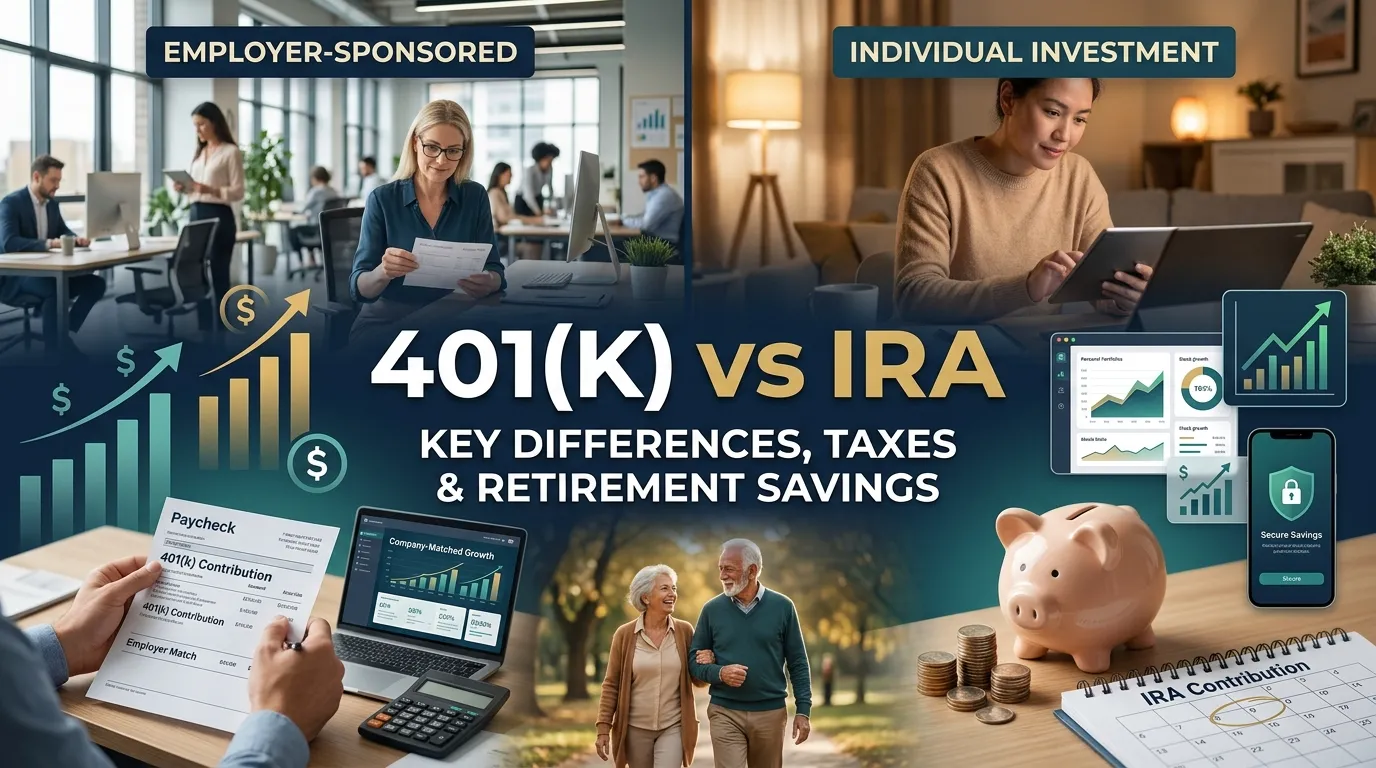
A 401(k) is an employer-sponsored retirement plan with much higher contribution limits and potentially an employer match.
An IRA is an individual retirement account that usually offers more investment flexibility.
For many Americans, the best strategy is to use both: contribute enough to the 401(k) to capture the full employer match, then consider an IRA before increasing 401(k) contributions further.
Key Takeaways
- A 401(k) is offered through an employer, while an IRA is opened individually.
- In 2026, the employee 401(k) contribution limit is $24,500, compared with $7,500 across all traditional and Roth IRAs combined.
- A 401(k) may include an employer match, while an IRA normally does not.
- IRAs generally offer a broader range of investments and more control over the account.
- You do not necessarily have to choose one. Using both can be an effective retirement strategy.
What Is a 401(k)?
A 401(k) is a retirement plan offered by an employer. Contributions are normally made through payroll deductions, making it easy to save automatically from each paycheck.
There are two major tax versions: traditional 401(k) and Roth 401(k).
With a traditional 401(k), contributions are generally made before federal income tax, and you generally pay income tax when you take taxable withdrawals later. A Roth 401(k) uses after-tax contributions, and qualified withdrawals can be tax-free.
One of the biggest advantages of a 401(k) is the possibility of receiving an employer match. For example, if your employer matches part of what you contribute, you can receive additional money in your retirement account based on your own contributions. Employer contributions can also have vesting rules, depending on the plan.
Traditional 401(k)
A traditional 401(k) can reduce your current taxable income because qualifying employee contributions are made on a pre-tax basis. The money can then grow tax-deferred until it is distributed.
Roth 401(k)
A Roth 401(k) uses after-tax contributions. You do not receive the same upfront tax deduction, but qualified withdrawals can be tax-free. Unlike a Roth IRA, a Roth 401(k) does not have the same direct income eligibility restriction for making contributions.
What Is an IRA?
IRA stands for Individual Retirement Account. Unlike a 401(k), an IRA is not dependent on an employer offering a workplace plan.
You can generally open an IRA through a financial institution such as a brokerage. Traditional and Roth IRAs have different tax rules.
A traditional IRA may provide a tax deduction for eligible contributions, while taxes generally apply to taxable withdrawals later. Roth IRA contributions are made with after-tax money, and qualified withdrawals can be tax-free.
Traditional IRA
A traditional IRA may be useful if you want potential tax benefits today and expect to pay taxes when withdrawing money during retirement.
However, whether your contribution is deductible can depend on your income, filing status, and whether you or your spouse are covered by a workplace retirement plan.
Roth IRA
A Roth IRA is funded with after-tax money. Qualified withdrawals can be tax-free, making it attractive to people who expect their future tax rate to be higher or who value tax-free retirement income.
Direct Roth IRA contributions are subject to income limits.
401(k) vs IRA: Key Differences
| Feature | 401(k) | IRA |
| Who offers it? | Employer | Individual financial institution |
| 2026 employee contribution limit | $24,500 | $7,500 combined |
| Employer match | May be available | Generally no employer match |
| Investment choices | Selected by plan | Usually broader |
| Payroll contributions | Common | Not required |
| Roth option | May be available | Roth IRA available |
| Account control | Tied to plan rules | Individually controlled |
| Income limits | Generally no income limit for regular 401(k) contributions | Rules vary by IRA type |
For 2026, the basic employee 401(k) elective-deferral limit is $24,500. The combined contribution limit for traditional and Roth IRAs is $7,500. People age 50 and older generally have additional catch-up opportunities.
Contribution Limits
The higher 401(k) limit is important for people who want to save a large percentage of their income.
For example, someone who wants to save $20,000 per year generally cannot put that entire amount into an IRA because of the lower IRA contribution limit. A 401(k) provides considerably more contribution room.
Employer Match
This is often the most important reason to prioritize a 401(k).
Suppose your employer offers a matching contribution and you contribute enough to receive the full match. Reducing your contribution below that level could mean missing out on part of the employer contribution available under your plan.
The exact match formula varies by employer, so check your plan documents before deciding how much to contribute.
Investment Choices
IRAs can offer considerable investment flexibility. Depending on the brokerage, you may have access to a wide range of mutual funds, ETFs, stocks, and bonds.
A 401(k), by contrast, generally gives you a menu of investments selected by the employer’s plan.
That does not automatically make an IRA better. A well-designed 401(k) with low-cost funds can be an excellent retirement account.
Taxes
Both account types can offer tax advantages, but the specific tax treatment depends on whether you use traditional or Roth contributions.
The basic comparison is:
- Traditional: potential tax benefit now, taxable withdrawals later.
- Roth: taxes paid upfront, qualified withdrawals generally tax-free later.
Your current tax bracket, expected future tax bracket, income, and retirement plans can all affect which option makes sense.
Eligibility and Income Rules
You can generally participate in a 401(k) when your employer offers one and you satisfy the plan’s eligibility requirements.
An IRA is individually established. Traditional IRA deduction rules and Roth IRA contribution rules can be affected by income and other circumstances.
For 2026, the IRS lists traditional IRA deduction phase-outs beginning at $81,000 for single or head-of-household filers and $129,000 for married couples filing jointly when the relevant workplace-plan coverage rules apply.
401(k) vs IRA: Which Should You Fund First?
For many people, the decision is not really 401(k) vs IRA. It is about deciding how to divide savings between the two.
When a 401(k) Comes First
A 401(k) is often the first priority when your employer offers a match.
A simple approach could be:
- Contribute enough to the 401(k) to receive the full employer match.
- Consider contributing to an IRA if it provides investment choices or tax features you prefer.
- If you still have money available for retirement, increase your 401(k) contributions.
This is not a universal rule. A 401(k) with unusually high fees or poor investment choices may change the calculation.
When an IRA May Be Better
An IRA may be attractive after capturing your employer match because you generally have more control over where the account is held and what investments are available.
For example, an investor whose workplace plan has a limited selection of expensive funds might prefer to direct additional retirement savings toward a low-cost IRA, assuming they qualify and have not reached the applicable contribution limit.
When Using Both Makes Sense
Using both accounts can provide a combination of benefits.
Imagine you contribute enough to your 401(k) to receive the full employer match. You then fund a Roth IRA for additional tax diversification and broader investment choices. After reaching the IRA limit, you can return to the 401(k) and increase contributions.
This approach can also help you build retirement savings across different tax treatments.
2026 Contribution Limits
The major numbers to know for 2026 are:
- 401(k): $24,500 employee elective-deferral limit.
- IRA: $7,500 combined annual contribution limit across traditional and Roth IRAs.
- IRA catch-up: $1,100 for eligible individuals age 50 or older.
- 401(k) catch-up: generally $8,000 for eligible participants age 50 or older, with a higher limit applying to certain participants ages 60–63.
These limits can change, so check current IRS guidance when making contribution decisions.
Common Mistakes to Avoid
Ignoring the employer match: If your plan offers matching contributions, understand the formula and vesting rules before deciding how much to contribute.
Assuming every 401(k) is better than every IRA: Account quality matters. Compare investment expenses, available funds, and plan features.
Thinking traditional and Roth accounts are identical: They can produce very different tax outcomes because the timing of taxation differs.
Forgetting the IRA contribution limit applies across IRA accounts: Opening multiple IRAs does not give you a separate annual limit for each account. The 2026 limit applies to your combined traditional and Roth IRA contributions.
Taking retirement money out too early: Withdrawals before age 59½ can trigger a 10% additional tax unless an exception applies, along with possible regular income tax.
One notable difference is that certain 401(k) distributions after separation from service at age 55 or later may qualify for an exception to the 10% additional tax, while IRA rules differ.
Frequently Asked Questions
Can I Have a 401(k) and an IRA?
Yes. Having both is common. A 401(k) can provide a higher contribution limit and potential employer matching, while an IRA can provide additional investment flexibility and another way to save with tax advantages.
Is a 401(k) Better Than an IRA?
Neither is automatically better. A 401(k) can be especially valuable when your employer provides a match or you want to save more than the IRA annual limit. An IRA may be attractive for its investment flexibility and individual control.
Should I Max Out My 401(k) or IRA First?
If your employer offers a match, a common starting point is to contribute enough to the 401(k) to receive the full match. After that, an IRA may be worth considering before putting additional money into the 401(k), depending on fees, investment choices, tax considerations, and your personal goals.
What Happens to My 401(k) If I Leave My Job?
Depending on the circumstances and plan rules, you may be able to leave the money in the former employer’s plan, roll it into a new employer’s plan, or roll it into an IRA. Review the tax and investment consequences before moving the money.
Conclusion:
The choice between a 401k vs IRA does not have to be an either/or decision.
A 401(k) generally wins on contribution capacity and can provide valuable employer matching contributions. An IRA often wins on investment flexibility and individual control. Traditional and Roth versions of both accounts also give you different ways to manage when you pay taxes.
For many workers, a practical starting point is to capture the full 401(k) employer match, consider an IRA for additional savings and flexibility, and then increase 401(k) contributions if more retirement savings are needed.
The best choice depends on your income, tax situation, employer plan, investment options, fees, and retirement goals. For important tax or investment decisions, consider reviewing your specific situation with a qualified financial or tax professional.

I am Noah Bennett, the creative mind behind DreamFlirtz, where style meets modern digital vibes. ✨
I am here to turn ideas into trends and make dreamflirtz.com stand out. 🚀