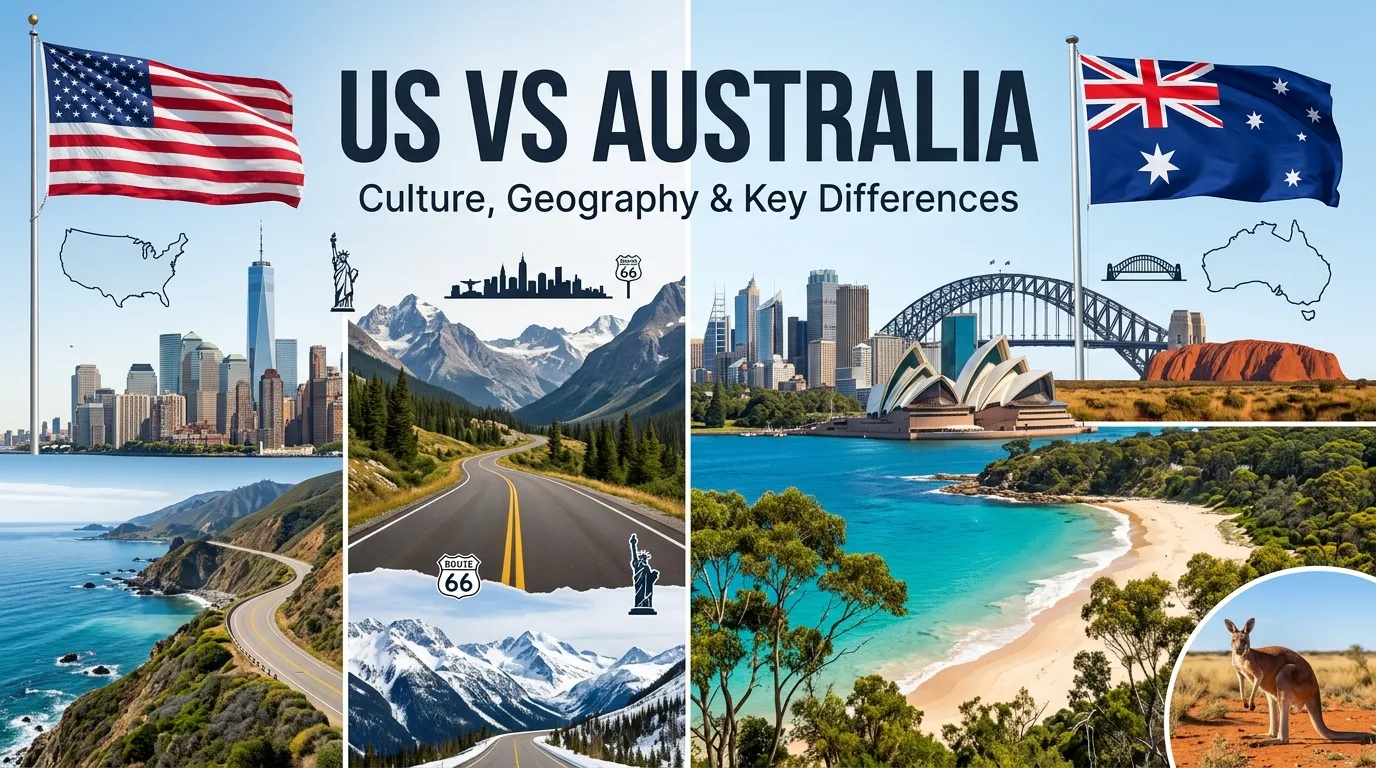
The US and Australia are both large, wealthy English-speaking countries, but they differ in population, government, healthcare, currency, driving rules, climate, and everyday life.
The US has a much larger population, while Australia has a smaller population spread across a vast landmass. Australia also uses a universal Medicare system and drives on the left.
Key Takeaways
- The United States has a much larger population than Australia.
- Australia covers about 7.69 million square kilometers, making it the world’s sixth-largest country.
- The US uses the U.S. dollar, while Australia uses the Australian dollar.
- Australia has a universal Medicare healthcare system, while the U.S. healthcare system relies heavily on private insurance alongside public programs.
- Australians drive on the left side of the road, unlike drivers in the United States.
US vs Australia: Quick Comparison
| Feature | United States | Australia |
| Capital | Washington, D.C. | Canberra |
| Population | About 341.8 million in 2025 | About 27.9 million in March 2026 |
| Area | One of the world’s largest countries | 7.69 million km² |
| Currency | U.S. dollar (USD) | Australian dollar (AUD) |
| Government | Federal constitutional republic | Federal parliamentary democracy |
| Healthcare | Mixed public and private system | Universal Medicare plus private healthcare |
| Road side | Right | Left |
| Major language | English | English |
| Seasons | Northern Hemisphere | Southern Hemisphere |
The population difference is especially large. The U.S. Census Bureau estimated the U.S. population at 341,784,857 on July 1, 2025, while Australia’s latest official estimate was 27,921,150 on March 31, 2026.
Size and Population
Which Country Is Bigger?
Both countries are geographically large, but comparing their exact areas can be complicated because different sources use different definitions of total area.
Australia’s official national area is approximately 7.69 million square kilometers. Geoscience Australia describes it as the world’s sixth-largest country and the smallest continental landmass.
The United States is also among the world’s largest countries and has a much larger population distributed across 50 states.
Australia’s large landmass can make the country seem much more densely populated than it actually is when looking at major cities. Most Australians live in or around a relatively small number of major urban areas, while huge parts of the country are sparsely populated.
The U.S., by comparison, has major population centers across several regions, including the Northeast, South, Midwest, and West.
Which Country Has More People?
The United States has dramatically more people.
The U.S. population was approximately 341.8 million in 2025. Australia’s population reached about 27.9 million in March 2026.
That difference affects everything from city size and domestic markets to transportation networks, housing patterns, and the number of large metropolitan areas.
Government and Political System
The United States and Australia are both federal countries, but their political systems are structured differently.
The U.S. federal government is divided into three branches: legislative, executive, and judicial. Congress forms the legislative branch, the president leads the executive branch, and federal courts make up the judicial branch.
Australia is a federal parliamentary democracy based on the Westminster tradition. Its federal system distributes powers between the Commonwealth government and Australia’s states and territories.
One noticeable difference is voting. Australian citizens aged 18 and over are required to vote in elections, while voting in U.S. elections is not compulsory.
These differences mean that although both countries are democracies with federal structures, their elections and government formation work differently.
Currency and Money
The United States uses the U.S. dollar (USD), which is the official currency of the country.
Australia uses the Australian dollar (AUD). The Reserve Bank of Australia publishes exchange-rate information showing the Australian dollar’s value relative to the U.S. dollar and other currencies.
For travelers, students, and businesses, exchange rates matter because the same numerical price can represent different purchasing costs after conversion.
For example, someone traveling from the U.S. to Australia should check the current exchange rate rather than assuming that an Australian price converts directly to the same amount in U.S. dollars.
Healthcare in the US vs Australia
Healthcare is one of the most important differences between the two countries.
Australia has a universal Medicare system. Eligible Australians can receive subsidized healthcare services, and Medicare provides access to public hospital services as well as subsidies for various medical services, tests, and other healthcare needs.
Australia also has a private healthcare sector. Private insurance can help cover certain hospital and other healthcare expenses outside the public system.
The U.S. healthcare system is more fragmented. Americans may receive coverage through employer-sponsored insurance, individual insurance, Medicare, Medicaid, or other arrangements depending on their circumstances.
For someone comparing the two countries, it is therefore more useful to examine insurance coverage, premiums, out-of-pocket costs, access, and eligibility rather than simply asking which healthcare system is better.
Education and Studying
Both countries have major universities and attract international students.
Australia has a structured system for international education. The Australian Government recommends using CRICOS, the Commonwealth Register of Institutions and Courses for Overseas Students, to check courses and institutions available to students on Australian student visas.
Australia also has legislation designed to protect international students. The ESOS framework establishes standards for providers and includes tuition-protection measures.
The U.S. has a much larger higher-education sector, with universities, colleges, community colleges, and professional institutions spread across the country.
Students comparing the US and Australia should look beyond rankings. Tuition, scholarships, program length, visa rules, housing, health coverage, employment opportunities, and the specific university can make a major difference.
Lifestyle and Everyday Life
American and Australian lifestyles share many similarities. English is dominant in both countries, both have large multicultural populations, and both have strong urban economies.
However, daily life can feel different because of geography, climate, population density, transportation, and local culture.
Australia’s major population centers are concentrated along the coast. Cities such as Sydney, Melbourne, Brisbane, Perth, Adelaide, and Canberra have different climates and lifestyles.
The U.S. offers a much wider range of large metropolitan areas and regional environments. Someone can choose from dense cities, suburbs, agricultural regions, mountain communities, deserts, coastal areas, and colder northern regions.
Driving and Road Rules
One of the easiest differences to notice is driving.
In the United States, vehicles generally travel on the right side of the road.
In Australia, drivers travel on the left side. The Australian Government specifically advises visitors to remember this when driving.
This matters for American tourists renting cars in Australia. Drivers must adjust to differences in road positioning, intersections, signs, lane discipline, and vehicle controls.
Distances can also be surprisingly large. Australia has enormous geographic distances between some cities. For example, the Australian Government lists the road distance between Sydney and Perth at more than 4,000 kilometers.
Climate and Seasons
Another major difference comes from location.
The United States is primarily in the Northern Hemisphere, while Australia is in the Southern Hemisphere. As a result, the seasons occur at opposite times of the year.
When it is summer in the United States, it is generally winter in Australia. When Americans experience winter around December and January, Australians are experiencing summer.
However, neither country has one single climate. The U.S. includes tropical, desert, temperate, alpine, and polar-influenced environments. Australia ranges from tropical areas in the north to temperate regions in the south and dry desert areas inland.
This means comparing “US weather” with “Australian weather” is too broad. The specific city or region matters.
Cost of Living
Cost of living is another area where simple countrywide comparisons can be misleading.
Housing, transportation, groceries, healthcare, education, taxes, and entertainment can vary substantially between cities in both countries.
For example, comparing Sydney with a small U.S. town produces a very different result from comparing Sydney with New York City, Los Angeles, Chicago, or another major metropolitan area.
Exchange rates also affect how Americans perceive Australian prices when traveling or moving abroad.
For a realistic comparison, compare the specific cities, expected income, rent or mortgage, transportation needs, healthcare costs, and lifestyle rather than assigning one country a blanket “more expensive” label.
Travel, Work, and Relocation
For Americans considering Australia, the biggest practical questions are usually visa eligibility, employment, housing, healthcare access, taxes, and distance from family.
Australia offers several visa categories for visitors, students, workers, and other purposes. Visa requirements depend on the applicant’s circumstances and the type of stay, so travelers should check current Australian Government requirements before making plans.
For students, Australia continues to maintain a regulated international education system. Current rules can change, so prospective students should check official government information before applying.
The physical distance is another practical consideration. Australia is far from the continental United States, so international flights can involve long travel times and substantial planning.
US vs Australia: Which Is Different for You?
The answer depends on what you are comparing.
For population and market size: the United States is substantially larger in population.
For geography: Australia is an enormous country with a relatively small population concentrated around coastal cities.
For healthcare: Australia has universal Medicare for eligible people, while the U.S. uses a more mixed insurance and public-program structure.
For driving: Americans need to remember that Australia drives on the left.
For education: both countries offer extensive higher-education choices, but international students should compare individual institutions, costs, visa conditions, and programs.
For climate: remember that Australia’s seasons are opposite to those in the U.S.
There is no single answer that applies to every traveler, student, worker, or family. The most useful comparison depends on the specific purpose of the move or trip.
Frequently Asked Questions
Is Australia bigger than the US?
Australia covers about 7.69 million square kilometers and is the world’s sixth-largest country. The United States is also among the world’s largest countries. Exact comparisons can vary depending on whether a source uses total area, land area, or another measurement.
Is healthcare free in Australia?
Australia’s Medicare system provides eligible people with access to subsidized healthcare and public hospital services. It does not mean every healthcare service is completely free. Some services and treatments can involve additional costs, and private healthcare operates alongside the public system.
Do Australians drive on the left?
Yes. Australia drives on the left side of the road. This is an important difference for Americans visiting or renting a car in Australia.
Is Australia more expensive than the US?
There is no single answer for the entire countries. Living costs vary considerably by city, housing choice, income, transportation, healthcare, education, and lifestyle. A city-to-city comparison is more useful than a countrywide generalization.
What is the main difference between the US and Australia?
The countries differ in several major ways rather than one single feature. The largest practical differences include population size, government structure, healthcare, currency, driving side, geography, and seasons. The United States has a much larger population, while Australia has universal Medicare for eligible residents and drives on the left.
Conclusion:
The US vs Australia comparison involves much more than two English-speaking countries with similar cultural connections. The United States has a much larger population and a broader network of major metropolitan areas, while Australia combines a huge landmass with a much smaller population.
Healthcare, education, government, currency, driving, climate, and cost of living also differ. For anyone considering travel, study, work, or relocation, the best comparison is based on the specific city and personal circumstances rather than a simple countrywide judgment.

I am Nathan Cole, exploring connections on DreamFlirtz.com I am confident, friendly, and always ready for a great chat.
I am someone who enjoys meeting amazing people and sharing good vibes. 🔥