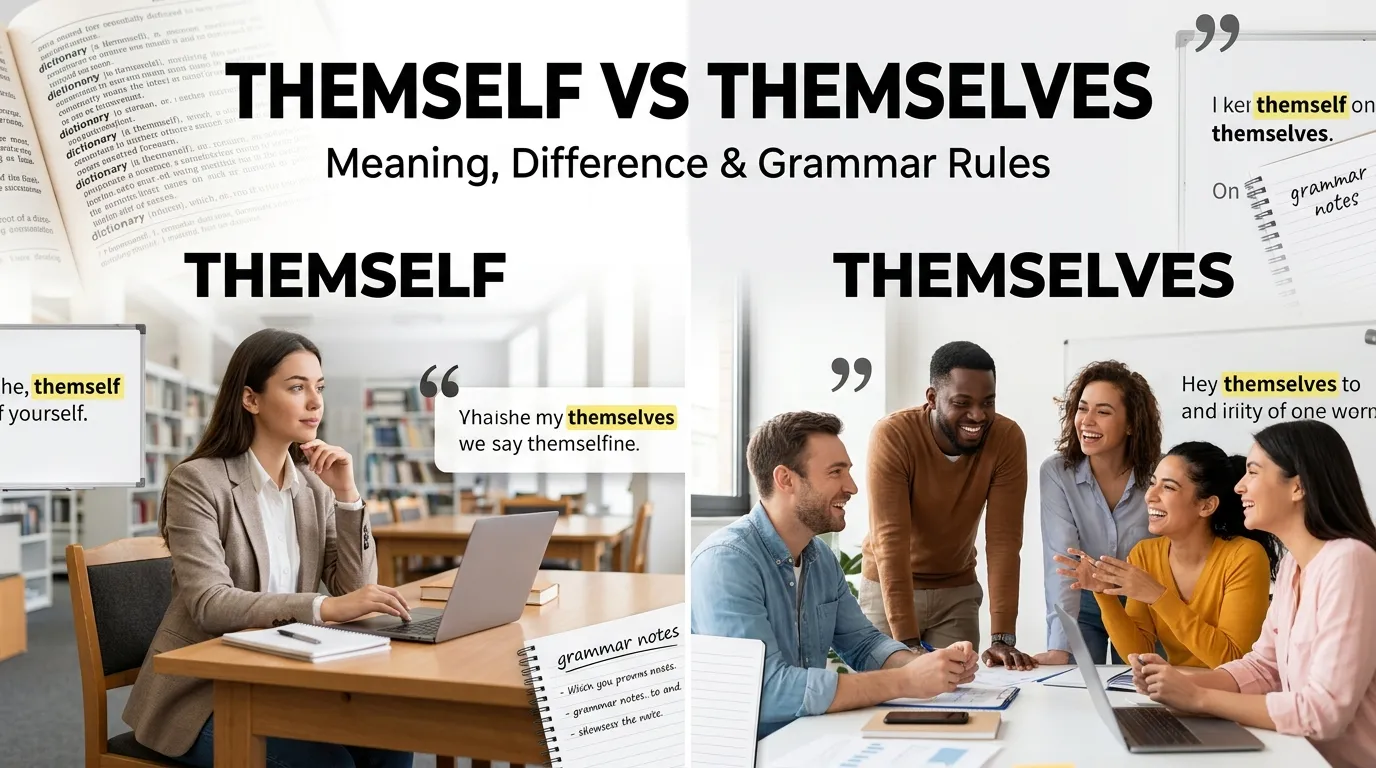
Themself and themselves are reflexive pronouns, but they are commonly used in different situations. Themselves is the established reflexive form for plural they.
Themself can be used when they refers to one person, especially with singular, gender-neutral they. However, usage and style guidance varies, so context matters.
Key Takeaways
- Themselves is the standard reflexive form when they refers to multiple people.
- Themself can refer to one person when that person uses singular they.
- Some style guides and dictionaries differ in how they treat themself.
- Themselves can also appear with singular they in established usage.
- The best choice depends on whether they refers to one person or more than one and, in some cases, the preferred style guide.
Themself vs Themselves: The Basic Difference
The main difference between themself and themselves is grammatical number and context.
Traditionally, themselves is the reflexive pronoun associated with plural they.
For example:
The students prepared themselves for the exam.
Here, they refers to several students, so themselves naturally refers back to that plural group.
Themself, on the other hand, is used by some writers and speakers when they refers to one person. For example:
Jordan reminded themself to bring an umbrella.
In this sentence, Jordan is one person, and they/them is being used as a singular pronoun.
Cambridge Dictionary currently lists themself as a pronoun used when they is singular or when referring to a single person whose gender is not specified.
The important point is that themself does not simply mean a “shorter” version of themselves. The choice is connected to how they is being used.
What Does “Themselves” Mean?
Themselves is a reflexive pronoun. It normally refers back to they when they represents multiple people.
For example:
- The children dressed themselves.
- The employees introduced themselves.
- The players congratulated themselves after the game.
- The guests served themselves dinner.
Cambridge defines themselves as the reflexive form of they and gives examples involving groups of people. It can also be used for emphasis, as in “They themselves made the decision.”
Examples of “Themselves”
Consider these sentences:
Correct:
The sisters bought the tickets themselves.
Correct:
The workers organized themselves into small teams.
Correct:
The children taught themselves how to play the game.
In each example, the pronoun refers to more than one person.
Themselves** can also appear after by to mean “alone” or “without help”:**
The students completed the project by themselves.
This is a common and well-established use.
What Does “Themself” Mean?
Themself is a reflexive pronoun used with singular they by some speakers and writers.
It can refer to one individual whose pronouns are they/them:
Alex taught themself to play guitar.
It can also be used when the gender of one person is unknown or deliberately not specified:
If someone wants to improve, they should challenge themself.
Cambridge specifically documents these uses, including examples such as “someone be themself” and “the parent themself.” At the same time, Cambridge labels the word “not standard,” showing that its status is not treated identically by all authorities.
That distinction is important: themself is a documented English usage, but it does not have exactly the same level of acceptance in every style system.
Themself vs Themselves: Comparison Table
| Feature | Themself | Themselves |
| Basic role | Reflexive pronoun | Reflexive pronoun |
| Common reference | One person using singular they | Multiple people using they |
| Example | Sam reminded themself | Sam and Lee reminded themselves |
| Number | Singular in this use | Usually plural |
| Used with singular they? | Yes, in documented usage | Yes, in some established contexts |
| Used with plural they? | Generally no | Yes |
| Formal acceptance | Varies by style guide | Broadly established |
The table shows why the question cannot always be answered simply by saying that one word is “right” and the other is “wrong.”
When Should You Use “Themselves”?
Plural They
Use themselves when they refers to two or more people.
For example:
The students introduced themselves.
The subject is the students, a plural group, so themselves is the natural reflexive form.
More examples:
- The parents prepared themselves for the meeting.
- The athletes pushed themselves during practice.
- The neighbors organized themselves into teams.
- The musicians taught themselves the new song.
This is the clearest and least controversial use of themselves.
Singular They
Modern English also uses singular they. This can refer to one person whose gender is unknown, unspecified, or who specifically uses they/them pronouns.
In these situations, themselves may also be used:
If a customer has a problem, they can contact customer service themselves.
Major style guidance recognizes singular they. The Chicago Manual of Style’s 18th edition, for example, endorses generic singular they in appropriate contexts and recognizes specific singular they as well.
This means that themselves is not automatically wrong just because they refers to one person.
When Should You Use “Themself”?
One Person Using Singular They
Themself is especially useful when you want the reflexive form to clearly match a singular individual.
For example:
Taylor reminded themself to call the doctor.
Here, Taylor is one person and uses they/them pronouns.
Another example:
The artist wanted to challenge themself with a new style.
The subject and reflexive object refer to the same individual.
The MLA Style Center explicitly notes that when a person uses singular they, both themselves and themself can occur. Its example gives “Ari read the instructions to themselves [or themself].”
Emphasis With Singular They
Themself** can also be useful when emphasizing the individual:**
The person themself should make the final decision.
This construction is documented by Cambridge.
It can make the singular reference especially clear.
Is “Themself” Grammatically Correct?
The answer depends on what you mean by correct.
If you mean, “Is themself an actual English word used by real speakers and recognized by dictionaries?” the answer is yes. Cambridge has a dedicated dictionary entry for it and provides examples of singular they paired with themself.
If you mean, “Do all dictionaries and style guides consider themself a standard choice?” the answer is no.
That is why you may encounter conflicting grammar advice online.
The MLA Style Center recognizes themself as an option with singular they. Meanwhile, Cambridge labels the term “not standard” while still documenting its actual usage.
So, rather than treating the issue as a simple right-versus-wrong rule, consider audience, context, the person’s pronouns, and the style guide you are following.
Common Mistakes to Avoid
1. Using “themself” for a group
Avoid:
The employees blamed themself.
When employees means several people, use:
The employees blamed themselves.
2. Assuming “themselves” can only refer to groups
Singular they is established in modern English, and themselves can occur with singular they in some contexts.
3. Ignoring someone’s stated pronouns
If a person uses they/them, follow that person’s pronouns rather than replacing them with gendered alternatives. MLA specifically advises writers to follow an individual’s personal pronouns.
4. Treating every grammar rule as universal
English usage changes over time, and different editorial authorities can make different recommendations. When writing for school, work, journalism, or publishing, check the style guide required by that organization.
Quick Rule for Choosing the Right Word
Use this simple approach:
If “they” means several people → use “themselves.”
The players congratulated themselves.
If “they” means one person → “themself” may be appropriate, especially when emphasizing the singular person.
The student reminded themself to study.
If your style guide permits singular “they” but prefers “themselves,” follow that guide.
The safest choice in professional writing is not simply to memorize one word. Instead, identify the antecedent, determine whether they is singular or plural, and follow the relevant editorial convention.
FAQs:
Is themself a real word?
Yes. Themself is documented in major dictionaries, including Cambridge. It is used with singular they when the pronoun refers to one person. However, Cambridge currently labels it “not standard,” while other style resources recognize it as a possible form.
Is themself singular or plural?
In its modern documented use, themself is singular. It is used when they refers to one person. For example, “The person should decide for themself.” Themselves is normally associated with plural they, although singular they can also take themselves in some usage.
Can you use themselves for one person?
Yes, in certain contexts. Singular they is widely recognized, and themselves may be used with it. The MLA Style Center explicitly gives themselves and themself as alternatives in an example involving one person who uses singular they.
What is the singular form of themselves?
There is no single universally required singular replacement. Themself is one option for singular they, while themselves is also used with singular they in established modern usage. The appropriate choice depends on context and style guidance.
Which is better in formal writing?
For plural they, use themselves. For singular they, check the style guide and audience. Some authorities accept or recognize themself, while others may prefer themselves. Chicago’s current guidance recognizes singular they in formal prose, illustrating how contemporary formal usage has evolved.
Conclusion:
The difference between themself vs themselves becomes much easier once you look at what they refers to.
Use themselves for a plural group: “The children enjoyed themselves.” With singular they, themself can be used when referring to one person, while themselves is also accepted in some modern usage.
The key is to consider the number of the antecedent, the person’s pronouns, and the style guide you are following. English usage around singular they continues to develop, so context matters more than a one-size-fits-all rule.

I am Noah Bennett, the creative mind behind DreamFlirtz, where style meets modern digital vibes. ✨
I am here to turn ideas into trends and make dreamflirtz.com stand out. 🚀