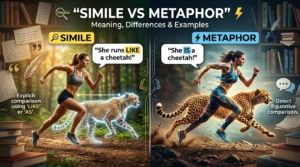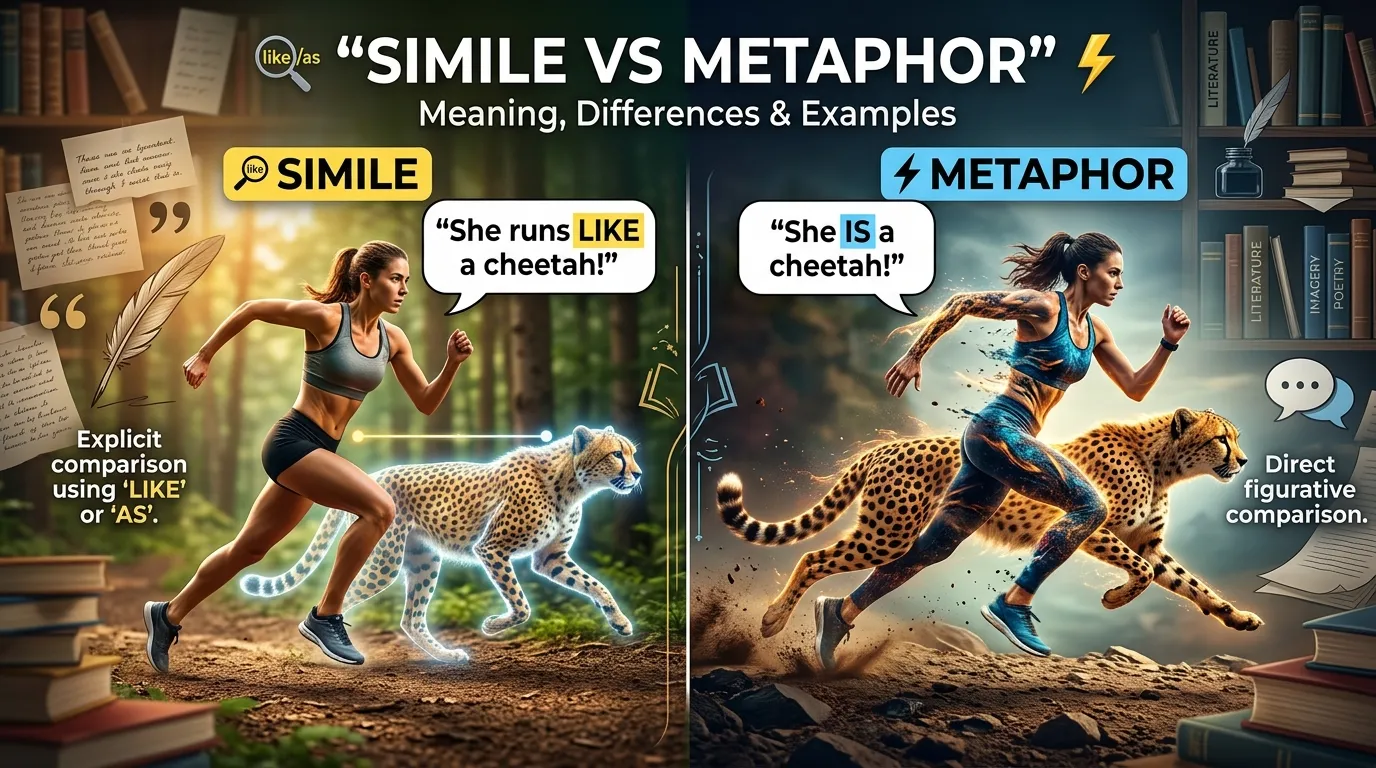
A simile compares two different things using words such as “like” or “as,” while a metaphor makes a more direct comparison by saying one thing is another.
For example, “She is like a star” is a simile, while “She is a star” is a metaphor. Both create vivid imagery, but they express comparisons differently.
Key Takeaways
- A simile makes an obvious comparison, usually with like or as.
- A metaphor makes a direct or implied comparison without saying like or as.
- Both are forms of figurative language used to make ideas more vivid.
- Similes often make comparisons easier to understand, while metaphors can feel stronger or more imaginative.
- The easiest test is to ask whether the writer is saying something is like something else or is something else.
What Is a Simile?
A simile is a figure of speech that compares two different things in a clear and direct way. It commonly uses words such as like, as, or sometimes than.
For example:
“Her smile was like sunshine.”
The person’s smile is not literally sunshine. The writer compares the smile to sunshine because both suggest brightness, warmth, or happiness.
Similes are useful because they help readers picture an idea quickly. Instead of simply saying that someone runs very fast, a writer might say:
“He runs like the wind.”
The comparison gives the reader a stronger mental image.
Similes appear in everyday conversations, stories, advertisements, poetry, songs, and other forms of writing.
Simple Simile Examples
Here are some original examples:
- The baby slept like a log.
- Her voice was as soft as a feather.
- The classroom was like a busy marketplace.
- He was as nervous as a cat.
- The water sparkled like glass.
- The children ran like deer across the field.
In each example, the comparison is clearly signaled.
How to Recognize a Simile
When you see a sentence, look for comparison words such as like or as.
For example:
“The clouds looked like cotton.”
Ask: Is one thing being compared to another?
Yes. Clouds are being compared to cotton.
That makes it a simile.
However, like does not automatically make every sentence a simile. In “I like pizza,” the word like expresses preference rather than comparison. Context matters.
What Is a Metaphor?
A metaphor is another type of figurative language that creates a comparison, but it usually does so more directly. Instead of saying that one thing is like another, the writer presents one thing as another.
For example:
“Her smile was sunshine.”
The smile is not literally sunshine. The metaphor connects the two ideas to suggest warmth, brightness, or happiness.
Metaphors can make writing feel more powerful because the comparison is presented as a direct statement rather than being openly introduced with “like” or “as.”
Simple Metaphor Examples
- The classroom was a zoo.
- Time is a thief.
- His words were knives.
- My brother is a walking encyclopedia.
- The city was a jungle.
- Her voice was music.
These statements are not meant literally. They use one idea to help readers understand another.
For example, “The classroom was a zoo” suggests that the classroom was noisy, chaotic, or difficult to control.
How to Recognize a Metaphor
Ask yourself:
Is the writer directly presenting one thing as another to show a shared quality?
Consider:
“The test was a nightmare.”
The test was not literally a nightmare. The writer uses nightmare to communicate that the test was extremely difficult, stressful, or unpleasant.
That is a metaphor.
Simile vs Metaphor: Key Differences
The easiest way to understand the difference is to place them side by side.
| Feature | Simile | Metaphor |
| Main function | Makes a comparison | Makes a direct or implied comparison |
| Common clue | Like, as, than | Often uses “is,” “was,” or direct association |
| Example | She is like a rose. | She is a rose. |
| Comparison style | Explicit | More direct |
| Typical effect | Clear and easy to visualize | Strong, vivid, or imaginative |
Both devices compare ideas, but the wording changes how the comparison feels. A simile openly tells the reader that two things are being compared. A metaphor asks the reader to understand the connection more directly.
Simile vs Metaphor Examples Side by Side
One of the easiest ways to learn the difference is to express the same idea in both forms.
Example 1: Someone Is Very Fast
Simile:
“He runs like a cheetah.”
Metaphor:
“He is a cheetah on the track.”
Both sentences communicate speed, but the simile clearly announces the comparison.
Example 2: Someone Is Very Kind
Simile:
“She is like an angel.”
Metaphor:
“She is an angel.”
The simile says she resembles an angel. The metaphor makes the comparison more directly.
Example 3: Someone Is Very Busy
Simile:
“He works like a machine.”
Metaphor:
“He is a machine at work.”
Example 4: A Difficult Situation
Simile:
“The negotiation was like a battlefield.”
Metaphor:
“The negotiation was a battlefield.”
These paired examples show why the distinction is mostly about how the comparison is expressed, not simply what two things are being compared.
How to Tell if a Sentence Is a Simile or Metaphor
Use this simple three-step test.
Step 1: Look for a comparison
Ask whether the sentence connects two different things or ideas.
For example:
“Her eyes were stars.”
Eyes and stars are different things, so a comparison is being made.
Step 2: Look for “like” or “as”
If the comparison uses like or as, it is often a simile.
“Her eyes were like stars.”
That is a simile.
Step 3: Check for a direct comparison
If the sentence presents one thing as another, it is generally a metaphor.
“Her eyes were stars.”
That is a metaphor.
This quick test works for many basic examples, although advanced figurative language can be more subtle.
When Should You Use a Simile or Metaphor?
Choose a simile when you want to make a comparison especially clear.
For example:
“The snow was as soft as cotton.”
The reader immediately understands the intended quality.
A simile can be helpful in descriptive writing because the comparison is easy to follow.
Choose a metaphor when you want a comparison to feel more direct, striking, or imaginative.
For example:
“The snow was a white blanket.”
The metaphor creates a stronger visual image by turning the snow into a “blanket” in the reader’s imagination.
Neither device is automatically better. The right choice depends on the effect you want.
Writers use both in poetry, fiction, speeches, everyday communication, and descriptive writing.
Simile vs Metaphor vs Analogy
A simile, metaphor, and analogy are related, but they do different jobs.
A simile makes a comparison:
“Learning a language is like climbing a mountain.”
A metaphor makes a more direct comparison:
“Learning a language is a journey.”
An analogy usually goes further by explaining how two situations or systems are similar.
For example:
“Learning a language is like training for a marathon: progress takes regular practice, patience, and consistency.”
The analogy does more than create an image. It uses one situation to help explain another.
So, a useful shortcut is:
- Simile: compares.
- Metaphor: directly connects or equates.
- Analogy: explains through a comparison.
Common Mistakes to Avoid
Mistake 1: Thinking every “like” is a simile
Not necessarily.
“I like chocolate.”
There is no comparison here. Like simply expresses preference.
Mistake 2: Assuming metaphors must use “is”
Many simple metaphors do use forms of to be, but metaphors can appear in more varied structures.
For example:
“The wind whispered through the trees.”
The wind is not literally whispering like a person. The human quality creates figurative meaning.
Mistake 3: Thinking metaphors are literal statements
When someone says:
“He has a heart of stone.”
They usually do not mean that his heart is physically made of stone. The phrase suggests emotional coldness or a lack of compassion.
Mistake 4: Thinking one is always better
Similes and metaphors serve different purposes. A simile may be clearer, while a metaphor may produce a stronger or more compact image. Good writing depends on choosing the device that fits the message.
Frequently Asked Questions
Is “like” always a sign of a simile?
No. “Like” can serve several grammatical purposes. In a sentence such as “She dances like a professional,” it creates a comparison and functions as a simile. But in “I like music,” there is no comparison. Always consider the meaning and context of the sentence.
Can a sentence contain both a simile and a metaphor?
Yes. A sentence can contain both forms of figurative language.
For example:
“She was an angel, shining like a star.”
“She was an angel” is a metaphor, while “shining like a star” is a simile. Writers can combine different devices to create layered descriptions.
Which is stronger, a simile or a metaphor?
Neither is automatically stronger. A metaphor can feel more direct because it presents the comparison as an identity, while a simile can make the connection clearer by explicitly signaling it. The best choice depends on the writer’s purpose and the effect they want.
What is the easiest way to remember the difference?
Remember this simple formula:
Simile = like/as comparison.
Metaphor = direct comparison.
For example:
“He is like a lion.” → Simile
“He is a lion.” → Metaphor
Once you recognize this pattern, identifying basic similes and metaphors becomes much easier.
Conclusion:
The difference between simile vs metaphor is mainly the way the comparison is presented. A simile makes an explicit comparison, commonly using like or as, while a metaphor creates a more direct or implied connection.
Think of:
“Her smile is like sunshine.” Simile
and:
“Her smile is sunshine.” Metaphor
Both sentences create a similar image, but they do it differently. Learning this distinction can make it easier to understand literature, improve school assignments, and write descriptions that are clearer and more memorable.