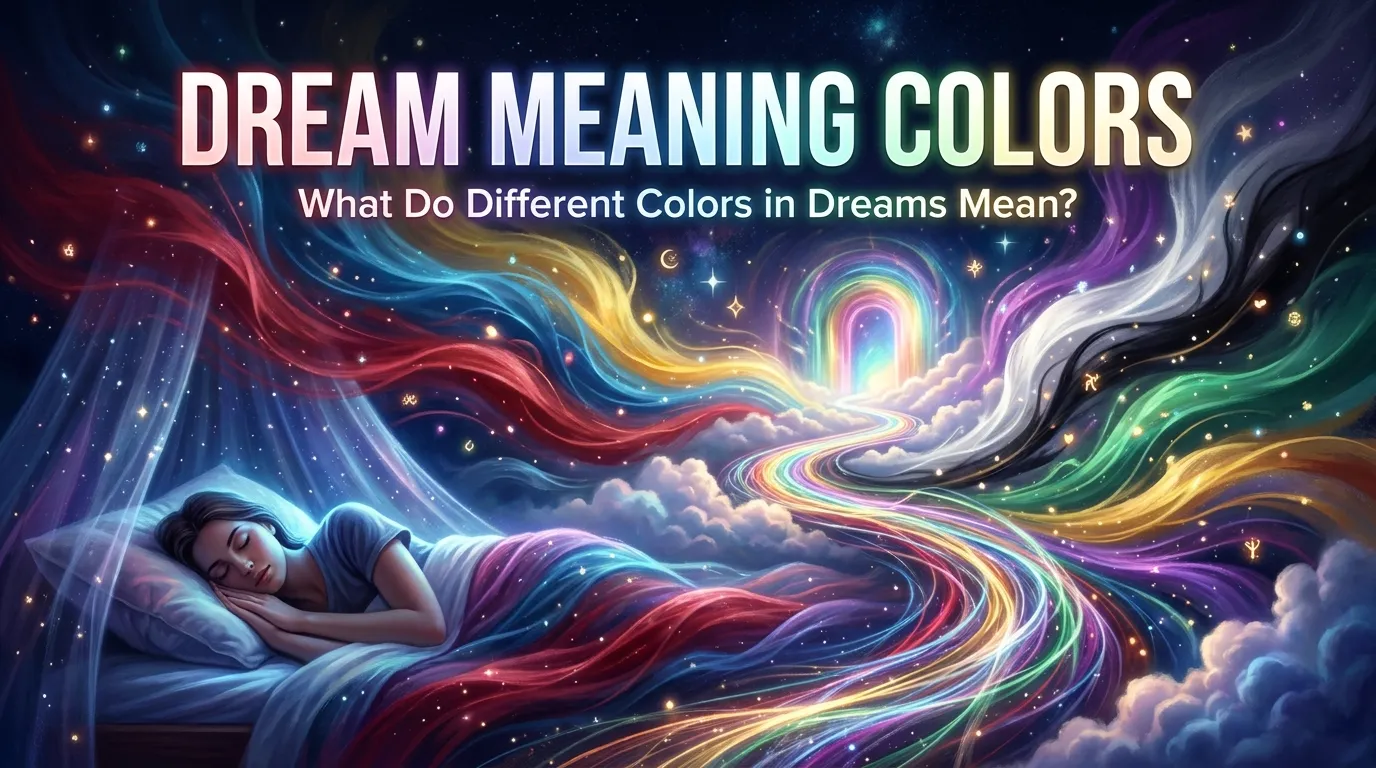
Have you ever woken from a dream remembering one thing more clearly than anything els the color? Maybe everything was covered in brilliant red, you were wearing white clothes, a mysterious blue light surrounded you, or a dark black landscape stayed in your mind long after waking.
You may wonder, “Why did I dream about these colors, and what could they mean spiritually?”
Colors in dreams can feel surprisingly powerful because they often connect with emotions, memories, inner experiences, and spiritual symbolism. While there is no single universal meaning for every color, the shades appearing in your dreams may offer clues about what your subconscious is processing.
The spiritual meaning of dreaming about colors can also be connected with personal growth, intuition, healing, relationships, energy, and your current life path. The meaning depends not only on the color itself but also on how you felt during the dream.
This guide explores the psychological, spiritual, cultural, and emotional meanings behind colors in dreams so you can reflect on what your own dream may be telling you.
Spiritual Meaning of Dreaming About Colors
Dream colors can symbolize different emotional and spiritual states. A bright color may represent energy, hope, excitement, or awareness, while a dull or disturbing color may reflect confusion, fear, sadness, or something unresolved.
From a spiritual perspective, colors are sometimes viewed as expressions of energy. Different traditions associate colors with qualities such as love, protection, wisdom, transformation, peace, or passion.
However, dream interpretation is personal. For example, red might symbolize love for one person and danger for another. Blue might represent peace to someone who loves the ocean but sadness to someone who associates blue with loneliness.
Therefore, ask yourself:
- What color stood out most strongly?
- How did you feel when you saw it?
- Was the color bright, dark, faded, or glowing?
- What object or person had that color?
- What is happening in your life right now?
- What personal memories do you associate with that color?
These questions can reveal more than a traditional color dictionary alone.
What Do Colors Represent in Dreams?
Here are some common symbolic interpretations of colors that appear in dreams.
| Dream Color | Possible Emotional Meaning | Possible Spiritual Meaning |
| Red | Passion, anger, desire | Life force, courage, transformation |
| Blue | Peace, sadness, trust | Intuition, communication, spiritual calm |
| Green | Growth, jealousy, renewal | Healing, balance, abundance |
| Yellow | Happiness, nervousness | Awareness, optimism, confidence |
| White | Peace, innocence, clarity | Purification, spiritual renewal |
| Black | Mystery, fear, grief | Transformation, hidden aspects of self |
| Purple | Creativity, mystery | Spiritual awareness, intuition |
| Orange | Excitement, confidence | Creativity, emotional energy |
| Pink | Affection, tenderness | Love, compassion, emotional healing |
| Brown | Stability, simplicity | Grounding and connection to earth |
| Gray | Uncertainty, neutrality | Transition, emotional detachment |
Remember that these are possibilities rather than fixed predictions.
Red in Dreams: Passion, Power, and Warning
Red is one of the most emotionally intense colors.
Dreaming of red may point toward passion, romance, anger, ambition, excitement, or strong personal energy. If you felt happy while seeing red, the dream could reflect confidence or emotional excitement.
If the red felt frightening, it might represent conflict, pressure, jealousy, or an emotional warning.
Spiritually, red is often associated with vitality and grounding. It can symbolize the desire to take action rather than remain passive.
A dream filled with red may therefore encourage you to examine where your energy is going.
Are you pursuing something meaningful, or are you reacting emotionally to a situation?
Blue in Dreams: Peace, Intuition, and Emotional Depth
Blue is commonly associated with calmness, communication, trust, and emotional depth.
Seeing a peaceful blue sky, ocean, room, or light in a dream may reflect a desire for emotional peace. A darker blue environment might suggest deeper feelings that you have not fully expressed.
Spiritually, blue is often connected with intuition and communication. A blue dream may encourage you to listen more carefully to your inner voice.
If you have recently been keeping your feelings inside, your dream could be inviting you to express yourself honestly.
Green in Dreams: Growth and Healing
Green often symbolizes nature, renewal, growth, balance, and healing.
Dreaming about green plants, trees, clothing, light, or landscapes may reflect personal development. It can appear during periods when you are beginning a new chapter or recovering emotionally from something difficult.
Green can also represent jealousy or insecurity, depending on the dream’s emotional atmosphere.
Spiritually, green is strongly connected with healing and the heart. Your dream may be encouraging you to forgive, reconnect, or create greater emotional balance.
Yellow in Dreams: Happiness, Awareness, or Anxiety
Yellow can have two very different meanings.
Bright yellow may symbolize happiness, optimism, creativity, confidence, and mental clarity. But unpleasant or dirty yellow may represent nervousness, caution, jealousy, or emotional discomfort.
Pay attention to the quality of the color.
A warm golden-yellow sunrise can carry a very different message from a disturbing yellow room.
Spiritually, yellow can symbolize awareness and personal confidence. It may appear when you are becoming more conscious of your choices and beginning to trust your abilities.
White in Dreams: Peace and Spiritual Renewal
White is often associated with purity, peace, innocence, simplicity, and new beginnings.
Dreaming about white clothing, white flowers, snow, light, or a bright white room may represent a desire for peace or emotional clarity.
From a spiritual perspective, white is frequently connected with purification and renewal.
If you have been experiencing emotional confusion, a white dream may symbolize your desire to release old burdens and start again.
However, white can also represent emptiness or emotional distance. Your personal feelings in the dream matter greatly.
Black in Dreams: Mystery and Transformation
Black dreams can sometimes feel frightening, but black does not automatically mean something negative.
Black can symbolize the unknown, hidden emotions, endings, mystery, protection, or transformation.
For example, walking through a dark landscape might represent uncertainty about your future. But wearing black clothing confidently could symbolize strength, independence, or acceptance of change.
Spiritually, darkness can represent the parts of yourself that you have not yet understood.
Instead of asking, “Is this a bad dream?” consider asking:
“What am I being invited to understand?”
Sometimes darkness in a dream represents the beginning of deeper self-awareness.
Purple in Dreams: Intuition and Spiritual Awareness
Purple has long been associated with mystery, imagination, creativity, spirituality, and wisdom.
Seeing purple light, clothing, flowers, or surroundings in a dream may indicate that you are paying more attention to your intuition.
A purple dream can also appear when you are exploring creativity or questioning deeper aspects of your life.
Spiritually, purple is sometimes associated with higher awareness and the search for meaning.
If the dream felt peaceful, it may symbolize inner growth. If it felt strange or overwhelming, it could indicate that you are trying to understand something that has not yet become clear.
Orange in Dreams: Creativity and Emotional Energy
Orange combines the intensity of red with the brightness of yellow.
It can represent enthusiasm, creativity, confidence, social energy, and emotional expression.
Dreaming of orange may occur when you are ready to try something different or express yourself more openly.
Spiritually, orange is often associated with creativity and emotional movement. It may encourage you to stop suppressing your natural enthusiasm.
If orange appears repeatedly, consider whether there is a creative idea you have been ignoring.
Pink in Dreams: Love, Compassion, and Tenderness
Pink is commonly connected with affection, kindness, romance, softness, and emotional vulnerability.
Dreaming about pink may reflect relationships, self-love, compassion, or a need for emotional comfort.
A beautiful pink flower might represent affection or new emotional possibilities, while faded pink could symbolize disappointment or nostalgia.
Spiritually, pink can remind you that healing does not always require strength and resistance. Sometimes healing requires gentleness toward yourself.
Brown in Dreams: Grounding and Stability
Brown is strongly connected with earth, home, stability, simplicity, and security.
Dreaming about brown landscapes, furniture, clothing, or animals may reflect practical concerns or your need to feel grounded.
If your life has recently felt chaotic, brown imagery may symbolize a desire for stability.
Spiritually, it can encourage you to reconnect with ordinary things—nature, routines, family, rest, and the physical world.
Gray in Dreams: Uncertainty and Transition
Gray often sits between black and white, making it a natural symbol of uncertainty.
Dreaming in gray may reflect indecision, emotional numbness, confusion, or a transitional period.
You may know that something in your life needs to change but not yet know what comes next.
Spiritually, gray can represent the space between chapters. It does not necessarily mean that you are lost. You may simply be in a period where clarity is still developing.
The Psychological Meaning of Colors in Dreams
Psychology offers another useful way to understand dream colors.
Dreams are influenced by memories, emotions, experiences, expectations, and associations. Your brain may use colors because they carry emotional meaning for you.
For instance, if you associate red with childhood celebrations, red might represent happiness rather than danger.
Likewise, someone who associates blue with a difficult period might experience blue dreams differently from someone who finds blue calming.
This is why dream interpretation should combine symbolism with personal context.
Instead of asking only, “What does red mean?”, ask:
“What does red mean to me?”
That question can lead to a much more meaningful interpretation.
Cultural Interpretations of Colors in Dreams
Color symbolism varies considerably between cultures.
In some traditions, white is strongly associated with purity and celebration, while in others it can be connected with mourning. Red may symbolize luck, celebration, love, danger, or power depending on cultural context.
Gold is frequently connected with wealth, success, divine qualities, or achievement.
Purple has historically been associated with royalty and spiritual authority in many societies.
Green often carries associations with nature, fertility, growth, and prosperity.
Because cultural meanings differ, it is important not to treat one interpretation as universal.
Your family background, religious traditions, cultural experiences, and personal memories may all influence what a particular color means in your dreams.
Colors and the Chakras
Some spiritual dream interpretations connect colors with the chakra system.
While chakras come from spiritual traditions rather than established scientific dream analysis, people sometimes use them as a reflective framework.
Red is commonly connected with the root chakra, representing grounding and security.
Orange is associated with the sacral chakra, connected symbolically with creativity and emotional expression.
Yellow relates to the solar plexus, often linked with confidence and personal power.
Green is associated with the heart chakra, representing compassion, love, and emotional balance.
Blue is connected with the throat chakra, symbolizing communication and self-expression.
Purple or indigo may be associated with higher intuition and spiritual awareness.
If a certain color repeatedly appears in your dreams, you might reflect on the emotional theme traditionally connected with that color.
For example, repeated blue dreams could encourage you to explore communication, while repeated green dreams might inspire reflection on emotional healing.
Dream Colors and Emotional Blockages
Sometimes a dream color can highlight an emotion you have been avoiding.
Imagine dreaming repeatedly about a locked red door. The red may represent passion, anger, urgency, or another personal association, while the locked door suggests something inaccessible.
The dream does not necessarily predict an event.
Instead, it may reflect an emotional question that deserves your attention.
Ask yourself:
What feeling does this color bring up in me?
That feeling may be more important than the traditional symbolic definition.
Why Do Some Dreams Have Very Bright Colors?
Bright colors can make dreams especially memorable.
A glowing blue light, golden sky, vivid red flower, or intensely green forest may indicate that the dream carried strong emotional significance.
Sometimes brightness simply reflects how strongly your brain encoded the dream.
From a spiritual perspective, some people interpret unusually vivid colors as signs of heightened intuition or emotional awareness.
Rather than assuming the dream predicts something, use its vividness as an invitation to reflect.
What was happening immediately before the color appeared?
What did you feel?
What happened afterward?
These details can help you understand the dream as a whole.
When You Dream in Black and White
Not everyone dreams with vivid colors.
A black-and-white dream may symbolize simplicity, nostalgia, emotional distance, uncertainty, or an experience connected with the past.
It can also simply reflect how your brain constructed that particular dream.
If you normally dream in color and suddenly experience a black-and-white dream, however, the difference may feel meaningful to you.
Consider whether you have recently been viewing a situation in an overly “right or wrong” way.
The dream may encourage you to recognize the gray areas in your life.
Real-Life Examples of Color Dreams
Example 1: A Red Room
A person dreams of standing inside a red room and initially feels uncomfortable.
Rather than automatically interpreting red as danger, they consider their current life. They realize they have been angry about a personal situation but avoiding the conversation.
The dream may reflect suppressed emotional intensity.
Example 2: A Blue Ocean
Someone dreams of swimming peacefully in a deep blue ocean.
They recently experienced a stressful period and have been searching for emotional calm.
In this context, blue may symbolize peace, emotional depth, and a desire to trust the natural flow of life.
Example 3: A Green Garden
A person dreams about walking through an enormous green garden filled with new plants.
They have recently started a new career path and are uncertain about where it will lead.
The green garden could symbolically represent growth, possibility, and a new stage of development.
Example 4: A White Light
Someone dreams of standing in a peaceful space surrounded by white light.
They have been trying to let go of an old relationship and move forward.
The dream may symbolize emotional release, peace, acceptance, or the desire for a fresh beginning.
These examples demonstrate why context matters. The same color can carry different meanings for different people.
How to Interpret Your Own Color Dream
If you want to understand the spiritual meaning of dreaming about colors, try this simple process.
1. Write down the colors immediately after waking.
Dream memories disappear quickly, so record them while they are fresh.
2. Identify the strongest color.
Which color attracted your attention most?
3. Record your emotions.
Were you peaceful, excited, frightened, confused, loved, or angry?
4. Look at the dream’s setting.
A color in a bedroom may mean something different from the same color appearing in a forest or sky.
5. Consider your personal associations.
What memories or experiences do you connect with that color?
6. Connect the dream to your current life.
Ask whether the dream reflects something you are currently experiencing.
7. Look for repeated patterns.
If the same color appears repeatedly, it may be worth exploring its emotional significance more deeply.
FAQs:
1. What is the spiritual meaning of dreaming about colors?
The spiritual meaning of dreaming about colors may relate to emotions, personal transformation, intuition, healing, or your current life path. The meaning depends on the color and the feelings surrounding it.
2. Does dreaming about a specific color predict the future?
Not necessarily. Dreams are generally better understood as reflections of emotions, memories, concerns, and personal experiences rather than guaranteed predictions of future events.
3. What does it mean to dream in very bright colors?
Very bright dream colors may reflect strong emotions or memorable experiences. Spiritually, some people interpret vivid colors as heightened awareness or intuition, but the personal context of the dream remains important.
4. Why do I keep dreaming about the same color?
A recurring color may represent an emotion, memory, concern, or theme that your mind continues to process. Reflect on what that color personally represents and what is happening in your life when the dreams occur.
5. Is dreaming about dark colors a bad sign?
No. Dark colors do not automatically represent something negative. They can symbolize mystery, change, hidden emotions, rest, uncertainty, or transformation. Your emotional response to the color is an important part of interpretation.
Conclusion:
The spiritual meaning of dreaming about colors is rarely about finding one perfect definition.
Instead, colors can act like emotional symbols within the language of your dreams. Red may awaken questions about passion or anger.
Blue may invite you toward peace and honest communication. Green can suggest growth and healing, while white may represent renewal. Dark colors may remind you that transformation often begins in places you do not yet understand.
Your dream belongs to your personal story.
So the next time you wake from a colorful dream, don’t immediately ask whether it is good or bad. Pause and ask:
What was I feeling? What was changing? What was I trying to understand?
Your answers may reveal that the most important message was never the color itself—but the emotion that the color helped you notice.
Dreams do not have to be frightening mysteries. They can become gentle invitations to slow down, listen inwardly, and understand yourself with greater compassion.

I am Nathan Cole, exploring connections on DreamFlirtz.com I am confident, friendly, and always ready for a great chat.
I am someone who enjoys meeting amazing people and sharing good vibes. 🔥