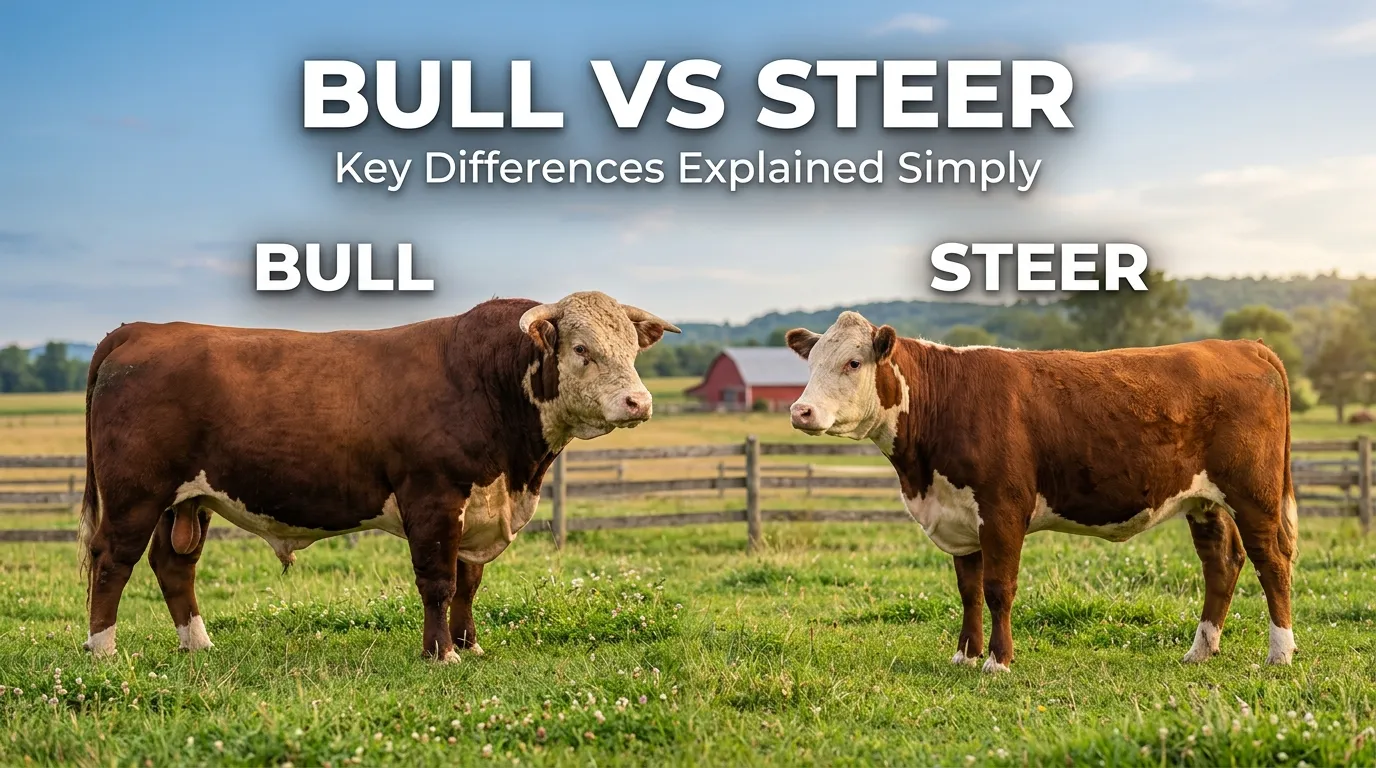
The main difference between a bull and a steer is reproductive status. A bull is an intact male bovine that can breed, while a steer is a male bovine that has been castrated and cannot normally reproduce.
Bulls are primarily used for breeding, while steers are commonly raised for beef because castration generally improves manageability and supports desirable carcass and meat-quality characteristics.
Key Takeaways
- A bull is an intact male cattle animal, normally kept for breeding.
- A steer is a castrated male cattle animal, commonly raised for beef.
- Bulls generally develop more pronounced muscular features because of testosterone.
- Steers are usually easier to handle and manage than intact bulls.
- Beef from steers generally has more desirable marbling and tenderness than beef from bulls, although results vary with age, genetics, nutrition, and management.
What Is a Bull?
A bull is an intact male bovine. In other words, he has not been castrated and retains his reproductive organs, allowing him to breed with cows and produce calves.
In cattle production, bulls have an important role in maintaining and improving a breeding herd. Producers may select bulls based on genetics, fertility, structural soundness, temperament, growth traits, and other characteristics that can influence the next generation.
Because bulls remain intact, testosterone affects their physical development after puberty. They can develop substantial muscle, particularly around the neck, shoulders, and forequarters.
However, a bull’s size or appearance alone does not define him. The most important distinction is that he is an intact male.
A young male cattle animal may also be called a bull calf before reaching adulthood. If that calf is later castrated, he becomes a steer.
What Is a Steer?
A steer is a male bovine that has been castrated. Castration removes or disables the testes, preventing normal reproduction and substantially reducing testosterone production.
Steers are widely used in beef production. They are generally easier to manage than intact males and are not kept for breeding.
Castration is a common cattle-management practice in the United States. Oklahoma State University Extension notes that producers commonly castrate bull calves that are not intended for breeding, and that steer calves can receive a market premium compared with comparable intact bull calves.
The timing and method of castration can vary according to the animal’s age, size, management system, and veterinary recommendations. Producers should use appropriate animal-welfare practices and veterinary guidance when needed.
Bull vs Steer: Key Differences
The easiest way to understand bull vs steer is to compare reproductive status, purpose, behavior, physical development, and beef characteristics.
Reproductive Status
This is the biggest difference.
| Characteristic | Bull | Steer |
| Sex | Male | Male |
| Castrated? | No | Yes |
| Can normally breed? | Yes | No |
| Common role | Breeding | Beef production |
| Testosterone | Higher | Much lower after castration |
A bull remains capable of reproduction, while a steer does not normally reproduce.
Purpose and Use
Bulls are primarily valuable as breeding animals. A single bull may be used to sire calves from multiple cows, depending on the breeding system.
Steers, on the other hand, are generally raised for beef production. Since they are not intended to contribute genetically to the herd, castration is commonly used as part of their management.
Not every male calf needs to become a steer. A producer may keep a genetically suitable male intact if the animal is intended to become a breeding bull.
Size and Physical Development
Bulls often develop a heavier, more muscular appearance than steers, particularly after puberty. Testosterone contributes to differences in muscle development and body composition.
Steers can still become large, powerful cattle. Their final size depends on breed, genetics, nutrition, age, health, and management—not simply on whether they are castrated.
Research comparing bulls and steers has found differences in growth and carcass characteristics, with bulls tending to produce heavier and leaner carcasses in some production systems.
So, saying that “all bulls are bigger than all steers” would be misleading.
Behavior and Handling
Bulls can be more difficult to manage because intact males may display breeding, dominance, mounting, and other behaviors associated with testosterone.
Castration generally reduces aggressive and mounting behavior, making steers more manageable in many production settings. Oklahoma State University Extension specifically notes that castration can reduce aggressive behavior and handling-related injury risks.
That does not mean every bull is aggressive or every steer is calm. Individual temperament, breed, handling history, environment, and training all matter.
Still, reproductive status is an important management difference between the two.
Growth and Feedlot Performance
The growth comparison is more complicated than simply saying bulls grow faster.
Intact bulls can have advantages in lean growth and carcass weight because of testosterone. However, steers can perform very well, and early-castrated calves may avoid some of the stress and performance problems associated with later castration.
Oklahoma State University research summaries report that steers can achieve comparable or better performance under particular management systems, while bulls may have advantages in pounds produced under other circumstances.
This means breed, nutrition, age, implant use, castration timing, and production goals all need to be considered.
Meat Quality
One of the most important practical differences involves beef quality.
Bull carcasses tend to be leaner and heavier, but beef from steers generally has advantages in characteristics such as marbling and tenderness. Oklahoma State University Extension states that beef from steers is generally more tender and has greater marbling than beef from bulls.
Nebraska research likewise reports that bulls can have greater hot carcass weight and muscle area while having lower marbling scores and less tender meat than steers.
However, meat quality is not determined by sex alone. Breed, age at slaughter, nutrition, genetics, stress, processing, and post-harvest handling also influence the final product.
Bull vs Steer Comparison Table
| Feature | Bull | Steer |
| Male? | Yes | Yes |
| Intact? | Yes | No |
| Castrated? | No | Yes |
| Reproductive ability | Yes | Normally no |
| Main agricultural role | Breeding | Beef production |
| Testosterone | Higher | Lower after castration |
| Typical appearance | More muscular, especially neck/shoulders | Often smoother body shape |
| Handling | Can be more challenging | Generally easier |
| Carcass | Often heavier and leaner | Often better marbling |
| Meat tenderness | Can be lower | Generally more favorable |
| Market use | Breeding or beef in some systems | Primarily beef |
These are general production differences, not absolute rules for every individual animal.
Why Are Male Calves Castrated?
A male calf may be castrated when the producer does not intend to use him for breeding.
There are several management reasons. Castration prevents reproduction, can make cattle easier to handle, and is associated with changes in growth and carcass development. It can also improve the marketability of calves in conventional beef production.
Timing matters. Oklahoma State University Extension reports that younger castration generally results in less stress and quicker recovery than delaying the procedure until the animal is older.
Castration is an animal-health procedure, so producers should follow appropriate techniques and consult a veterinarian when necessary.
Which Produces Better Beef: Bull or Steer?
For typical beef-quality goals, steers are generally favored for their carcass and eating-quality characteristics.
Steers tend to deposit intramuscular fat earlier and more evenly, contributing to marbling. Bulls can produce leaner and heavier carcasses, but the tradeoff can include reduced tenderness and marbling.
This does not mean beef from a bull is automatically poor quality. Age, genetics, nutrition, finishing program, stress, and processing can make a substantial difference.
The important distinction is that bulls and steers can be managed toward different production goals.
Can a Steer Reproduce?
No. A steer is a castrated male and is therefore not normally capable of reproducing.
This is why a steer is different from a bull even though both are male cattle. The word steer describes the animal’s reproductive status, not simply its age or size.
If a young male calf is selected for breeding, he remains intact and may eventually become a bull. If he is castrated because he is intended for beef production, he becomes a steer.
Bull vs Steer vs Cow vs Heifer
Cattle terminology can be confusing because several terms describe sex, reproductive status, or age.
- Bull: Mature intact male cattle.
- Steer: Castrated male cattle.
- Cow: Mature female cattle that has generally had a calf.
- Heifer: Female cattle that has not yet had a calf.
- Calf: A young bovine, male or female.
The American Farm Bureau Foundation for Agriculture similarly distinguishes bulls as adult males used for breeding and steers as neutered males.
This is why saying “male cow” can cause confusion. In everyday speech, people sometimes use “cow” to mean cattle generally, but in livestock terminology, cow specifically refers to a mature female.
FAQs:
Is a steer a male cow?
A steer is a male bovine, but technically he is not a “cow.” In livestock terminology, a cow is a mature female. A steer is a castrated male, while a bull is an intact male.
Are bulls bigger than steers?
Bulls often develop more muscle and can produce heavier carcasses because they remain intact and have higher testosterone levels. However, size varies widely with breed, age, genetics, nutrition, and management, so a bull is not automatically larger than every steer.
Are bulls more aggressive than steers?
Intact bulls can display more breeding and dominance-related behavior than steers, which can make handling more challenging. Castration generally reduces aggressive and mounting behavior, although individual temperament still varies.
Why are steers commonly raised for beef?
Steers are commonly raised for beef because they cannot reproduce, are generally easier to manage, and tend to develop carcasses with more favorable marbling and tenderness characteristics than intact bulls.
Can a steer become a bull?
No. Once a male calf has been castrated, it is considered a steer and cannot naturally develop into a breeding bull. A male calf must remain intact to mature into a bull.
Conclusion:
The simplest way to remember bull vs steer is this: a bull is an intact male, while a steer is a castrated male.
Bulls are primarily associated with breeding and can develop greater muscle and lean growth under certain conditions.
Steers are primarily raised for beef and are generally easier to manage, with carcass characteristics that are often preferred for meat quality.
Neither term simply means “big male cow.” Understanding the difference between reproductive status, production purpose, behavior, and carcass traits makes cattle terminology much easier to understand.

I am Nathan Cole, exploring connections on DreamFlirtz.com I am confident, friendly, and always ready for a great chat.
I am someone who enjoys meeting amazing people and sharing good vibes. 🔥